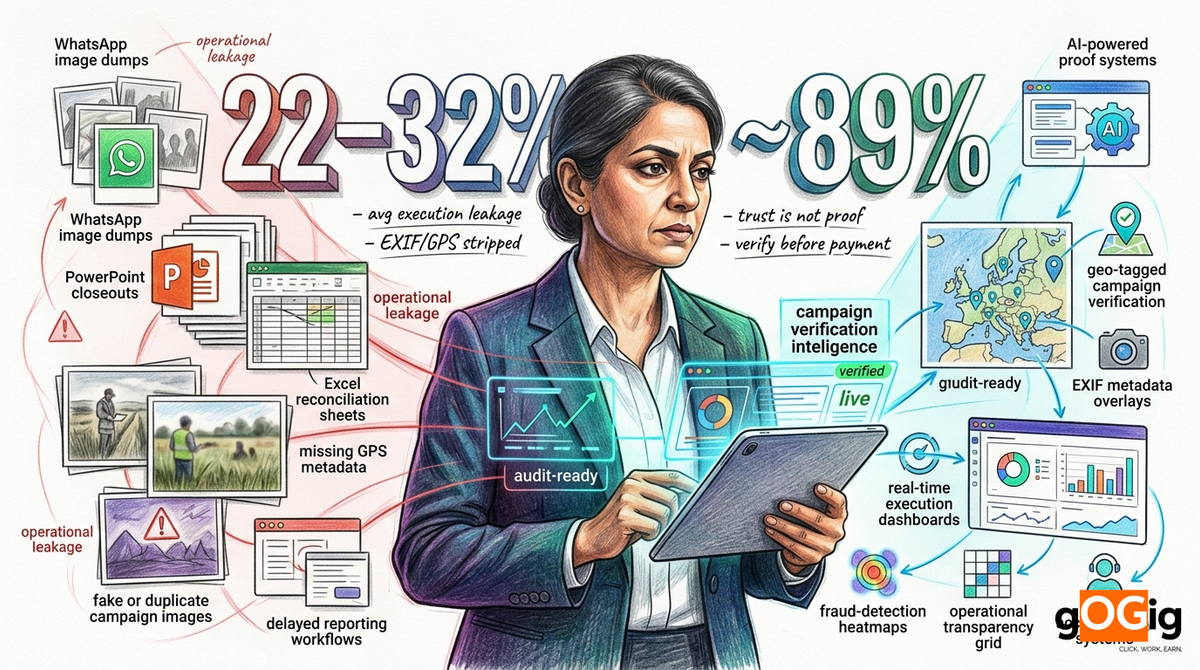
How do I verify if my offline marketing vendor actually executed the campaign?
A practical 2026 framework for brand managers, procurement leads, CFOs, and marketing operations heads who need to know whether the campaign their agency invoiced actually happened. Built around 7 verification steps, 5 core questions, and the AI-driven proof stack replacing WhatsApp + PPT closeouts.
22–32%
Avg execution leakage absorbed by Indian brands relying on WhatsApp photos and PPT closeouts as vendor proof. The single most expensive habit in Indian marketing operations. Verifying whether the vendor actually executed the campaign is not a process question; it is a P&L question.
A brand manager at a top-50 Indian FMCG receives the quarterly BTL closeout PPT from her agency. 4,200 outlets activated. 96% compliance reported. ₹3.2 Cr invoice attached. Three weeks later, an internal audit picks 50 outlets at random and physically visits. 18 outlets show no evidence the activation ever happened. 11 outlets received the wrong creative. 9 outlets received it but the POSM was removed within 7 days. The actual verified execution rate: 64%, not 96%. ₹1.1 Cr of the invoice rests on activity that cannot be substantiated. The brand manager is not unusual. She represents the operational default of Indian marketing in 2025.
The 5 questions every brand should ask before paying any offline marketing invoice
1. Did the activity actually happen?
2. Did it happen at the correct location?
3. Did it happen at the correct time?
| Question | Manual proof (WhatsApp + PPT) | Verified proof (gOGig AI) |
|---|---|---|
| Did the activity actually happen? | Vendor self-attestation | 9-layer mock-location detection + face match + liveness |
| Did it happen at the correct location? | GPS reported by app (spoofable) | 100% mock-location detection + cross-source check |
| Did it happen at the correct time? | Vendor-supplied timestamp | Server-side timestamp + behavioural anomaly check |
| Was the execution compliant? | Subjective photo review | AI creative-match at SKU/POSM level (100% accuracy) |
| Does the proof justify payment? | 'It looks correct' | Per-outlet verified execution scorecard + 3-way matching |
4. Was the execution compliant with the brief?
5. Does the proof justify the payment?
The 7-step framework to verify offline marketing vendor execution
Step 1 — Demand a pre-campaign baseline audit
If there is no baseline, there is no accountability.
What to require before vendor begins execution
- Geotagged baseline images of every outlet, OOH site, or wall in the campaign brief
- Exact location coordinates for every campaign asset (pincode + lat/long)
- Creative version records for every campaign asset (creative ID, design version)
- Placement position documentation (which shelf, which wall section, which side)
- Timestamped pre-installation proof with verified metadata
- Retailer / site owner OTP confirmation of campaign start
Step 2 — Stop accepting WhatsApp photos as proof
A static photo is a claim, not operational truth.
Why WhatsApp evidence fails
| WhatsApp evidence problem | Why it doesn't qualify as verification |
|---|---|
| EXIF / GPS metadata stripped | ~89% of standard mode uploads lose location data |
| Image can be recycled | Same photo used across campaigns; no hash detection |
| Image can be edited | Photoshopped/AI-altered images appear identical |
| Photo can come from anyone | No identity link between sender and rep on ground |
| Upload timestamp does not equal activity timestamp | Photo taken yesterday, uploaded today, still appears 'compliant' |
| No structured audit trail | Chat history not procurement-defensible |
| No 7-year retention | BRSR Core audit-grade impossible |
Step 3 — Verify location AND time simultaneously
Most brands verify only 'where'. Very few verify 'when'. Real verification requires both.
The location + time verification stack
| Layer | What it confirms |
|---|---|
| GPS coordinates (live capture) | Location at moment of capture (not later) |
| Server-side timestamp | When the activity actually happened (not when uploaded) |
| 9-layer mock-location detection | GPS authenticity (catches spoofing apps) |
| Telco / IP cross-check | Cellular network location matches reported GPS |
| Movement intelligence | Detects impossible travel speeds between sites |
| Behavioural anomaly classifier | Catches identical visit-duration clustering, repeated framing |
| OTP retailer confirmation | Third-party verification of rep visit |
Step 4 — Demand outlet-level execution visibility
Never accept 'campaign completed successfully'. Demand per-outlet logs.
What an outlet-level scorecard should contain
| Per-outlet data point | Why it matters |
|---|---|
| Visit start time and end time | Operational adherence to brief |
| Live timestamped photos (3–5 per outlet) | Continuous documentation |
| Creative-match score (AI verified) | Did the right creative get installed? |
| Planogram compliance score | Shelf placement vs approved planogram |
| POSM placement verification | Right POSM, right position, right condition |
| Outlet OTP confirmation | Retailer cross-verification of visit |
| Visit route logged | Pre/post outlets visited that day |
| Missing-location report | Outlets in brief but not visited |
| Same-day rectification status | Issues flagged and fixed on visit |
| Per-vendor scorecard impact | Vendor accountability roll-up |
Step 5 — Run AI anomaly detection across the submission set
Manual review cannot scale across thousands of outlets, hundreds of cities, and lakhs of field interactions. AI can.
10 anomaly patterns AI detects that humans miss
| Anomaly pattern | Manual detection | AI detection |
|---|---|---|
| Duplicate image (exact match) | 4–8% | 100% (SHA-256) |
| Duplicate image (perceptual near-match) | 2–4% | 100% (perceptual hash) |
| Impossible travel speed | ~0% | 100% (route reconstruction) |
| Identical visit-duration clustering | ~0% | 100% (behavioural anomaly) |
| Repeated framing patterns | ~0% | 100% (CV pattern matching) |
| Geo-spoofing (mock location apps) | ~0% | 100% (9-layer detection) |
| End-of-day batch upload signature | 6–12% | 100% |
| Multiple visits from identical coordinates | ~0% | 100% |
| Edit-signature on submitted images | ~0% | 100% (edit-signature analysis) |
| Cross-vendor asset re-use | ~0% | 100% (asset re-use sequence detector) |
Step 6 — Move to Proof-Before-Payment (PBP)
Do not approve invoices on PPT decks or verbal confirmation. Tie payment to verified execution.
The PBP procurement discipline
| Procurement step | Pre-PBP | With PBP |
|---|---|---|
| PO raised | Standard | Standard |
| Field execution | Vendor executes; self-reports | Vendor executes; gOGig captures verified evidence in parallel |
| Invoice submission | Vendor sends invoice + PPT | Vendor invoice auto-matched to verified execution data |
| Invoice verification | Manual review 30–80 hours | 3-way matching automated |
| Payment threshold | Subjective | Per-line-item: >=verified-threshold required |
| Approval workflow | CMO/CFO sign-off | System-generated; CMO/CFO countersign exceptions only |
| Dispute cycle | 14–22 days | 2–3 days |
| Payment cycle | 60–90 days | 14–22 days |
| Vendor satisfaction | Mixed (slow payment) | High (fast payment for verified work) |
| Audit committee defensibility | Weak | Strong |
Step 7 — Conduct random third-party verification audits
Even with strong systems, independent audits remain critical for behavioural accountability.
The audit cadence that works
| Audit type | Frequency | Sample size |
|---|---|---|
| Surprise outlet checks | Monthly | 2–5% of outlets |
| Mystery shopper audits | Quarterly | 1–2% of outlets |
| Random location validation | Continuous (AI-driven) | 100% of submissions |
| Cross-verification sampling | Monthly | 5–8% of outlets |
| Vendor-side surveillance audits | Quarterly | Top 3–5 vendors |
| Customer OTP retailer surveys | Per-campaign | 20–30% of outlets |
| Stakeholder feedback collection | Per-campaign | Per-outlet |
Get verification-grade vendor accountability in 21 days
Free 30-Day Verification Challenge on one live campaign. We deploy 9-layer mock-location detection, SHA-256 + perceptual hash, AI creative-match, behavioural anomaly classifier, and per-vendor scorecards. Field force continues using WhatsApp. 100% verification accuracy. 100% fraud detection rate.
100%
Verification accuracy
100%
Fraud detection rate
21 days
Pilot deployment time
What a properly verified campaign should include (4 layers)
Layer 01 — Operational layer
Live execution dashboard. Outlet-level visibility. Route intelligence. Geofenced check-ins. Real-time campaign map. Activity stream by territory.
Layer 02 — Proof layer
Timestamped images. Live-capture validation. Metadata integrity. AI-assisted image analysis. Creative-match scoring. SHA-256 + perceptual hash. Edit-signature detection.
Layer 03 — Accountability layer
Compliance scoring per outlet. Missing-location alerts. Audit logs. Vendor traceability. Per-vendor Tier A+ to D scorecard. Per-territory accountability roll-up.
Layer 04 — Financial layer
Proof-before-payment approvals. Invoice-linked verification. Exception reporting. Dispute-ready audit trail. 3-way matching with PO + invoice + verified delivery. 7-year structured retention.
Vendor red flags: 12 signals your vendor may not be executing
| Red flag | Significance |
|---|---|
| Photos arrive in end-of-day batches | Likely shot at one time, not over the day |
| Same backgrounds in different 'outlets' | Recycled or stock photos |
| Identical visit durations across outlets | Synthetic data pattern |
| Reports always 100% compliant | Statistical impossibility at scale |
| 'Lost connectivity' or 'GPS issue' frequent | Cover for non-execution |
| Reps move impossibly fast between sites | Geographic fraud |
| Photos with no EXIF metadata | WhatsApp standard or manually scrubbed |
| POSM photos show no surroundings | Studio-shot, not on-site |
| Vendor refuses live-capture requirements | Indicates concern about real conditions |
| Vendor objects to OTP confirmation from retailer | Avoiding third-party verification |
| Invoices increase without proportional outlets | Padding or scope creep without execution |
| Vendor pushes back on per-outlet visibility | Reluctance to grant accountability |
The verification scorecard: what good looks like
| Indicator | Tier A+ vendor | Tier C-D vendor |
|---|---|---|
| Verified Execution Rate | 92–98% | 52–72% |
| Anomaly flag rate | <2% | 14–26% |
| Photo authenticity rate | 100% | 62–84% |
| GPS authenticity rate | 100% | 78–92% |
| Creative-match accuracy | 96–100% | 62–82% |
| Outlet OTP confirmation rate | >=85% | <=62% |
| Same-day rectification rate | >=80% | <=40% |
| Avg invoice dispute days | 2–3 days | 14–22 days |
| Avg payment cycle (with PBP) | 14–22 days | 45–60+ days |
| Contract renewal probability | ~92% | ~38% |
The cost of NOT verifying vendor execution
| Cost dimension | Annual impact per ₹100 Cr BTL spend |
|---|---|
| Execution leakage absorbed | ₹22–32 Cr |
| Manual reconciliation cost | ₹0.4–0.9 Cr |
| Invoice dispute resolution overhead | ₹0.3–0.6 Cr |
| Audit committee remediation | ₹0.3–0.8 Cr |
| Delayed payment cash-flow cost | ₹0.6–1.4 Cr |
| Wrong-creative POSM execution cost | ₹1.5–3 Cr |
| Stockout impact (FMCG) | ₹2–5 Cr |
| BRSR Core preparation cost | ₹0.4–0.9 Cr |
| Trade scheme leakage | ₹2–4 Cr |
| Total cost of not verifying | ₹30–52 Cr per ₹100 Cr BTL spend |
If a brand believes its vendor executed the campaign because the vendor said so, the brand is operating on faith, not on infrastructure. In 2026, every offline marketing rupee should pass through a verification layer before it leaves the bank. The cost of that layer is approximately 1–3% of operating expense. The leakage it prevents is 22–32%. The math is not subtle.
Verification readiness checklist: 22 questions to ask before signing your next BTL contract
Will you provide geotagged baseline images of every campaign asset before execution begins?
Will photos be live-captured at the site or accepted as WhatsApp forwards?
Will every submission preserve EXIF and GPS metadata?
Will photos pass SHA-256 and perceptual hash uniqueness check?
Will GPS authenticity pass 9-layer mock-location detection?
Will every visit be cross-verified via outlet OTP confirmation?
Will creative-match be AI-verified at SKU/POSM level?
Will server-side timestamps validate activity time (not upload time)?
Will route intelligence detect impossible travel speeds?
Will behavioural anomaly classifier catch identical visit-duration clustering?
Will edit-signature detection catch Photoshopped or AI-altered images?
Will per-outlet execution scorecards be available in real-time?
Will missing-location reports be generated daily?
Will per-vendor scorecards be refreshed weekly?
Will 3-way matching of PO + invoice + verified delivery be possible?
Will proof-before-payment workflows be operational?
Will audit-grade structured retention be maintained for 7 years?
Will BRSR Core-ready evidence pack be exportable on demand?
Will random third-party audits be permitted in contract terms?
Will Verified Execution Rate (VER) be a contractual KPI?
Will Return on Verified Execution (RoVE) be measured?
Will Verified by gOGig (or equivalent independent verification) certification be required?
Manual verification vs AI-verified pipeline (operating reality)
| Dimension | Manual verification | AI-verified pipeline |
|---|---|---|
| Coverage of submissions | 5–15% sampling | 100% |
| Fraud detection rate | 6–22% | 100% |
| Time per submission verified | ~3–8 minutes | ~3 seconds |
| Cost per submission verified | ₹80–180 | ₹3–12 |
| Auditor subjectivity | +-14–26 pp | +-2–4 pp |
| Data latency to dashboard | 2–7 days | Real-time |
| Audit-grade retention | Manual collation | 7-year structured retention |
| BRSR Core readiness | Manual exercise | API-ready, on-demand |
| Scalability | Plateau at ~2–4% of activity | 100% of activity at scale |
| Year-1 ROI | Baseline | 4–8x |
Frequently Asked Questions
Get verification-grade vendor accountability in 21 days
Free 30-Day Verification Challenge on one live campaign. We deploy 9-layer mock-location detection, SHA-256 + perceptual hash, AI creative-match, behavioural anomaly classifier, and per-vendor scorecards. Field force continues using WhatsApp. 100% verification accuracy. 100% fraud detection rate.
100%
AI accuracy
100%
Detection rate
4–8x
Year-1 ROI
Written by
gOGig Editorial
gOGig Research
gOGig Editorial Team
Was this article helpful?
Your feedback helps us write better content.