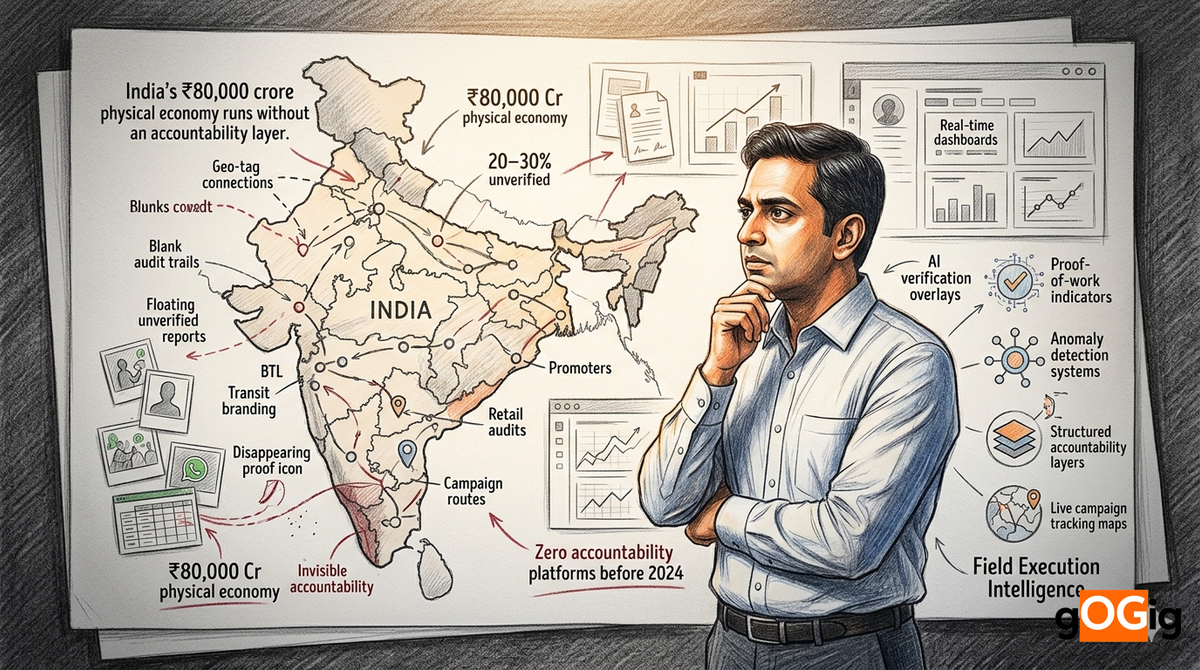
India's physical economy is ₹80,000 crore. Why doesn't it have an accountability layer yet?
India is the largest physical economy in the world operating without dedicated verification infrastructure. The reason is structural. The opportunity is generational. This is the macro thesis for Field Execution Intelligence, by the numbers.
₹80,000 Cr
Annual physical economy spend in India across BTL, OOH, field force, trade activation, and on-ground vendor work. Zero purpose-built accountability platforms existed before 2024.
The digital advertising industry has built a $1.5 billion verification software market to police its own fraud. India's physical economy, 2.6 times larger than India's total digital ad spend, has none.
The macro picture in one slide
| Macro indicator | 2024 | 2026 projection |
|---|---|---|
| India total ad spend | ₹1,01,084 Cr | ₹1,15,460 Cr |
| Physical economy spend (BTL+OOH+field+activation) | ₹72,000 Cr | ₹80,000 Cr |
| Digital ad spend | ₹30,000 Cr | ₹35,000 Cr |
| Live events & experiential | ₹15,000 Cr | ₹17,000 Cr |
| OOH market | ₹5,920 Cr | ₹6,800 Cr |
| Unverified physical economy spend | ₹14,400–21,600 Cr | ₹16,000–24,000 Cr |
| Field Execution Intelligence software market | ~₹0 Cr (pre-category) | Emerging |
The seven anchor numbers
What "physical economy" actually contains
| Component | Annual spend (₹Cr) | Share of physical economy |
|---|---|---|
| BTL activations | 22,000–26,000 | 27–32% |
| Trade promotions (FMCG, consumer) | 15,000–18,000 | 19–23% |
| Field force operations (pharma, BFSI, telecom) | 10,000–12,000 | 13–15% |
| OOH media (hoardings, transit, street furniture) | 5,920–6,800 | 7–9% |
| Live events & experiential | 15,000–17,000 | 19–21% |
| Retail visibility & merchandising | 4,000–5,000 | 5–6% |
| Rural BTL (wall painting, mela, haat) | 2,500–3,500 | 3–4% |
| Influencer activation (physical events) | 1,500–2,000 | 2–3% |
| Total physical economy | ~₹80,000 Cr | 100% |
By format, granular breakdown
| Format | Typical campaign scale | Annual market spend |
|---|---|---|
| Wall painting | 15K–50K sq ft per campaign | ₹2,000–2,800 Cr |
| Mobile vans & roadshows | 5–50 vans per campaign | ₹1,200–1,800 Cr |
| Pole boards & hoardings (OOH) | 500–5,000 units per campaign | ₹3,500–4,200 Cr |
| No-parking boards | 500–2,000 per launch | ₹400–700 Cr |
| Bus & cab branding (transit) | 50–2,000 vehicles per campaign | ₹1,500–2,200 Cr |
| Auto rickshaw branding | 500–10,000 autos per market | ₹600–900 Cr |
| Shop name boards | 5,000–50,000 per program | ₹2,000–3,000 Cr |
| Visual merchandising (retail) | 500–10,000 outlets monthly | ₹3,500–4,500 Cr |
| Sampling drives | 5K–50K outlets per campaign | ₹4,500–6,000 Cr |
| Promoter activations (mall & society) | 10–200 promoters per event | ₹3,000–4,000 Cr |
| Field sales & door-to-door | 1K–50K visits per month | ₹6,000–8,000 Cr |
| Lead generation activation | 500–5,000 leads per event | ₹2,000–3,000 Cr |
| RWA & society activation | 20–500 societies per launch | ₹1,000–1,500 Cr |
| Technician & install verification | 1K–100K installs per month | ₹2,500–3,500 Cr |
| Franchise compliance audit | 50–2,000 outlets monthly | ₹600–900 Cr |
| Security guard patrol verification | Continuous, multi-site | ₹3,500–4,500 Cr |
Read the gOGig vision
The full strategic thesis on Field Execution Intelligence as the next-decade infrastructure layer for India's physical economy. Macro sizing, competitive landscape, expansion roadmap, exit comparables.
Download the vision document →The digital vs physical accountability gap
| Dimension | Digital advertising | India physical economy |
|---|---|---|
| Global market size | $517B (eMarketer) | India physical economy ₹80,000 Cr (~$9.6B) |
| Annual ad fraud cost (global) | $41.4B–$120B (Spider Labs, ANA) | India BTL leak ₹15–20K Cr (~$1.8–2.4B) |
| % of spend lost to fraud | 20–30% globally | 20–30% in India BTL |
| Verification software market | $1.5B (2024) to $5B (2033) | Pre-category (zero baseline) |
| Verification market CAGR | 15.2% | Category creation phase |
| Major platforms | DoubleVerify, IAS, White Ops, Pixalate, Confiant | Field Execution Intelligence emerging |
| Industry body coverage | MRC, TAG, IAB, ANA | None at category level |
| Years of accountability infrastructure | 20+ (since Google Analytics 2005) | 0–2 (since 2024) |
Global ad fraud benchmark trajectory
| Year | Estimated global ad fraud cost | Source |
|---|---|---|
| 2018 | $35 Bn | ResearchAndMarkets |
| 2019 | $42 Bn | ResearchAndMarkets |
| 2022 | $68 Bn | Juniper Research |
| 2023 | $88 Bn | Statista |
| 2024 | $37.7–100 Bn | Spider Labs / Juniper / FTC |
| 2025 | $41.4–120 Bn | Spider Labs / WFA / ANA |
| 2028 projection | $172 Bn | Statista |
Digital ad fraud built a $5B verification software industry to police itself by 2033. India's larger physical economy still has no equivalent infrastructure layer at scale.
India's structural reality, by the numbers
| Indicator | India | Implication |
|---|---|---|
| Population | 1.43 Bn | Largest consumer market by population |
| Villages | 6,40,000+ | Largest unstructured rural distribution challenge |
| FMCG retail outlets | 13 million kirana / 2.6M+ verified large-format | Largest informal retail universe globally |
| Smartphone users | ~750M | Largest mobile-first workforce |
| WhatsApp users | 500M+ | Largest single-app field force coverage |
| Listed companies (NSE) | 2,100+ | Largest base for BRSR-driven regulatory pull |
| BRSR-mandated top 1,000 listed | 1,000 | Direct BRSR Core regulatory pressure |
| MSME-classified enterprises | 63M+ | Significant base of field execution vendors |
| BTL agency count | 2,000+ across 14+ tier-1 cities | Highly fragmented vendor landscape |
| Pharma medical reps per major company | 12,000–15,000 | Single industry, single role, scale defining |
Why India is structurally unique for FEI
| Structural condition | Other markets | India |
|---|---|---|
| Retail formality | 70–90% organised | 15% organised |
| Trade promotion share of FMCG revenue | 5–10% | 15–20% |
| Physical share of total ad spend | 30–45% | ~70% |
| WhatsApp penetration | 30–60% in major markets | 80%+ smartphone-using India |
| Smartphone penetration of workforce | 50–75% | 85%+ in field workforce |
| Geographic dispersion | Concentrated | 6,40,000+ villages |
| ESG / value chain regulation | Emerging | BRSR Core mandatory FY 2025-26 |
Adjacent categories: what FEI is not
| Adjacent category | Global market size | What it covers | Gap vs FEI |
|---|---|---|---|
| Retail Execution Software | $304M (2025) | In-store audits, planogram compliance, POS data | Organised retail focus, misses 85% of Indian retail |
| Field Service Management | $5.49B (2025) | Technician scheduling, dispatch, work orders | Service operations, not marketing accountability |
| Field Sales Software | $2.8B (2023) | Sales rep route, CRM sync, DCR | Self-reporting model, no independent verification |
| EHS / Audit Platforms | $3.1B (2024) | Compliance inspections, safety audits | Safety focus, not BTL fraud patterns |
| Frontline Operations Platforms | ~$2.7B (SafetyCulture valuation) | Inspection checklists, workforce ops | Generic, not category-specific to BTL |
| Workforce Management | $8.9B (2024) | Scheduling, time, attendance | HR operations, not execution verification |
| Digital Ad Verification | $1.5B (2024) to $5B (2033) | Pixel fires, IVT, MRC accreditation | Digital channel only, no physical execution |
Where FEI sits in the stack
| Layer | Existing category | Field Execution Intelligence position |
|---|---|---|
| Workflow tools | Email, WhatsApp, Slack | Sits on top of WhatsApp infrastructure |
| Data capture | Custom apps, Excel | Replaces with structured platform capture |
| Verification logic | Manual audit, photo review | AI verification at submission |
| Reporting | PDF decks, dashboard tools | Real-time accountability dashboards |
| Audit & assurance | External audit firms | Audit-grade evidence trails by default |
| Procurement integration | SAP, Coupa, Oracle | 3-way match data layer |
Why no accountability layer exists today
| Structural barrier | Why it blocked the category | Resolved by |
|---|---|---|
| Smartphone penetration sub-scale (pre-2018) | Field force could not consistently capture digital evidence | ~750M smartphone users by 2025 |
| GPS accuracy in tier-3 and rural India | Location data unreliable for verification | Modern GPS + EXIF + accelerometer cross-checks |
| Workforce digital literacy | Field teams resistant to app-based workflows | WhatsApp-native verification eliminates new-app friction |
| Verification cost > leak cost | Physical audits cost more than the inflation they caught | AI verification at fractions of a rupee per submission |
| No category vocabulary | Buyers and builders could not articulate the solution | "Field Execution Intelligence" defined in 2025 |
| CFOs not in marketing accountability conversation | Verification stayed inside marketing's "execution noise" framing | BRSR Core + audit committee oversight |
| BTL agencies rewarded for execution, not verification | Industry incentives misaligned with transparency | Procurement-driven Proof Before Payment shift |
| Fragmented industry data | No single dataset large enough to characterise fraud patterns | gOGig Labs Q1 2026 dataset (10,000+ submissions) |
The 2024–2026 convergence: why now
| Force | Status pre-2024 | Status 2026 |
|---|---|---|
| Verification cost per submission | ₹40–80 | ₹5–15 |
| India smartphone penetration | ~50% population | ~52% population, 85%+ field workforce |
| WhatsApp users in India | ~400M | 500M+ |
| BRSR Core mandatory | Not yet introduced | Top 250 listed FY 2025-26 |
| AI inference cost per image | ₹10–20 paise | <5 paise |
| CFO engagement on marketing | Rare | 60%+ of top 500 brands |
| Audit committee BTL findings | Rare | Recurring across listed entities |
| Industry vocabulary for the category | None | "Field Execution Intelligence" emerging |
Why this is generational, not cyclical
| Historical infrastructure layer | Window of creation | India market size today |
|---|---|---|
| Telecom mobile infrastructure | 2000–2010 | ₹4,00,000+ Cr revenue annually |
| UPI / digital payments rails | 2016–2020 | 178 Bn+ transactions in 2024 |
| E-commerce logistics infrastructure | 2014–2022 | ₹2,30,000+ Cr GMV (2024) |
| Digital advertising analytics | 2005–2015 | ₹35,000 Cr annual spend |
| Field Execution Intelligence | 2024–2030 | ₹80,000 Cr addressable today |
Infrastructure pattern recognition
| Pattern element | Past infra plays | FEI play |
|---|---|---|
| Triggering tech shift | 4G rollout, smartphone, payment APIs | AI inference at edge + WhatsApp Business API |
| Regulatory enabler | TRAI / RBI / IRDAI / SEBI | SEBI BRSR Core value chain assurance |
| Behavioural enabler | UPI: free P2P, smartphone normal | WhatsApp ubiquity for field workforce |
| Network effect | Each new user grew the system | Each new vendor + brand = larger dataset, better AI |
| Category creator advantage | Paytm, Flipkart, Jio, BharatPe | gOGig and Field Execution Intelligence |
FEI market sizing
| Market layer | 2026 estimate | 2030 projection |
|---|---|---|
| TAM (India physical economy spend) | ₹80,000 Cr | ₹1,20,000+ Cr |
| SAM (BTL + OOH + trade + field force, enterprise) | ₹55,000 Cr | ₹85,000+ Cr |
| SOM (top 1,000 listed Indian companies, FY 2027) | ₹20,000–25,000 Cr | ₹40,000+ Cr |
| Verification software revenue (% of SOM) | 0.3–0.5% | 1.5–2.5% |
| India FEI software revenue addressable | ₹60–125 Cr | ₹600–1,000 Cr |
| India FEI software revenue addressable (USD) | $7–15M | $72–120M |
| Global expansion adjacent markets | Pre-stage | $300–500M addressable |
Comparable category trajectory benchmarks
| Category | Creator company | Time to category recognition | Peak valuation |
|---|---|---|---|
| Revenue Intelligence | Gong | ~5 years | $7.25 Bn |
| Inbound Marketing | HubSpot | ~7 years | $30+ Bn (public) |
| Customer Success | Gainsight | ~5 years | $1.1 Bn |
| Collaboration Hub | Slack | ~4 years | $27.7 Bn (acquisition) |
| Frontline Operations | SafetyCulture | ~6 years | $2.7 Bn AUD |
| Digital Ad Verification | DoubleVerify / IAS | ~8 years | $5+ Bn (combined public market cap) |
| Field Execution Intelligence | gOGig | 2024–2027 (in progress) | To be defined |
Industry exposure to the accountability gap
| Industry | Annual physical economy spend | Unverified exposure | FEI adoption status |
|---|---|---|---|
| FMCG & consumer goods | ₹22,000–26,000 Cr | 25–30% | Scaling rapidly |
| Pharma | ₹10,000–12,000 Cr | 20–25% | Scaling |
| Cement, paint & building | ₹8,000–10,000 Cr | 18–22% | Early |
| Telecom & consumer durables | ₹7,500–9,000 Cr | 15–20% | Building momentum |
| Auto & 2-wheeler | ₹6,000–7,500 Cr | 15–18% | Building |
| Real estate & construction | ₹5,000–6,500 Cr | 20–25% | Early |
| BFSI | ₹4,500–6,000 Cr | 12–15% | Leading |
| QSR & multi-outlet retail | ₹3,500–4,500 Cr | 10–15% | Early adopter |
| Edtech | ₹2,500–3,500 Cr | 15–20% | Building |
| D2C brands | ₹2,000–3,000 Cr | 18–25% | Early |
Operational pain points being addressed
| Pain point | Documented impact | FEI resolution |
|---|---|---|
| FMCG outlet duplication | 1.6M reported outlets expanded to 2.6M verified, eliminating duplicates and fakes | Geo-locked outlet IDs + image fingerprinting |
| OOH installation audit failure | 4.2% of 1,200 hoardings non-compliant in single sampled audit | Real-time geo-tagged install verification |
| Field force productivity loss to manual reporting | 15–30% productivity loss across pharma, BFSI, telecom field force | WhatsApp-native capture eliminates parallel reporting |
| GPS spoofing in field submissions | 7% of submissions show mock-location app usage (gOGig Labs Q1 2026) | Mock-location detection + EXIF cross-check |
| Trade scheme leakage | 12–18% of FMCG scheme budgets unsubstantiated (KPMG) | Verified secondary sales claim tracking |
| Influencer fraud at physical events | Estimated 20–25% fake attendance / engagement claims | Geo + timestamp + identity verification at event |
| Re-execution costs when fraud detected late | 30–60% of original campaign value | Real-time detection mid-campaign |
| Marketing accountability under BRSR Core | Top 1,000 listed companies required to substantiate | Audit-grade evidence with 7-year retention |
| CMO impact measurement gap | Only 35% of Indian marketers can prove campaign impact (IBM 2025) | Verified execution rate as ROAS-equivalent metric |
India's accountability infrastructure maturity vs global
| Geography | Physical economy maturity | Verification infrastructure status |
|---|---|---|
| USA | ~$120B physical retail marketing | Mature, retail execution software ~$200M+ deployment |
| UK | ~$15B physical retail marketing | Mature, audit infrastructure consolidated |
| EU (DACH region) | ~$25B physical retail marketing | Mature, ESG-driven verification rising |
| China | ~$80–100B physical retail marketing | Mature, platform-mediated commerce dominant |
| India | ~$9.6B physical economy | Pre-category, FEI emerging |
| Southeast Asia (Indonesia, Vietnam, Thailand) | ~$15–20B combined | Pre-category, follows India lead |
| Middle East (GCC) | ~$8–12B | Early, follows global enterprise standards |
| Africa (Nigeria, South Africa, Kenya) | ~$10–15B combined | Pre-category, mobile-first opportunity |
Global expansion adjacency for FEI
| Market | WhatsApp penetration | Physical economy maturity | FEI fit |
|---|---|---|---|
| Indonesia | ~84% smartphone users | $12–15B | High - similar informal retail |
| Brazil | ~96% smartphone users | $25–30B | High - WhatsApp-dominated workforce |
| Mexico | ~93% smartphone users | $10–12B | High - mobile-first field force |
| Nigeria | ~85% smartphone users | $5–8B | High - informal retail dominant |
| South Africa | ~87% smartphone users | $3–4B | Medium-high - retail formalising |
| Bangladesh | ~70% smartphone users | $2–3B | High - mobile + informal retail |
| Sri Lanka | ~65% smartphone users | $1–1.5B | Medium |
| UAE | ~95% smartphone users | $3–4B | Medium - more formalised retail |
The competitive landscape in India
| Player type | What they do | Gap vs FEI |
|---|---|---|
| BTL agencies (in-house tools) | Custom photo + dashboard apps for own clients | Self-reporting, no independent verification |
| Field force tracking apps | GPS + DCR for sales teams | Marketing accountability not core, no AI verification |
| Audit consultancies (KPMG, EY, Deloitte) | Periodic spot audits | Snapshot, not continuous, expensive |
| Retail execution software (global) | Planogram and shelf compliance | Organised retail focus, misses informal BTL |
| Custom-built enterprise tools | Brand-specific verification builds | Single-brand, no benchmark dataset, high TCO |
| WhatsApp + Excel (the habit) | Default workflow at 85% of brands | Not a verification system, structural failure |
| Field Execution Intelligence (gOGig) | WhatsApp-native, AI-verified, multi-format, real-time | Category creator, proprietary dataset moat |
Why competitive moats compound for FEI
| Moat type | Source | Strength |
|---|---|---|
| Data network effect | Each new submission improves AI fraud detection | Compounding |
| WhatsApp integration moat | Workflow built natively, not bolted on | Architectural |
| Multi-format unification | 16+ BTL formats in one platform | Operational |
| Proprietary benchmark dataset | gOGig Labs Q1 2026: 10,000+ submissions analysed | Research / PR |
| Agency partnership flywheel | Agencies use verification as pitch differentiator | Channel |
| BRSR Core regulatory pull | Compliance teams demand verification platform evidence | Regulatory |
| India-first architecture | Built for informal retail, rural BTL, WhatsApp-dominated workforce | Geographic |
| Procurement integration | 3-way matching workflow with major ERP systems | Enterprise lock-in |
Maturity model for the category
Pre-category
No vocabulary, no benchmarks, no platforms. India BTL through 2023.
Category named
First-mover platforms define vocabulary. Industry trade publications begin coverage. India FEI in 2024–2025.
Early adoption
First 100–200 enterprise brands deploy. Proprietary research published. India FEI in 2026.
Analyst coverage
Gartner, Forrester, IDC publish category reports. Standards bodies engage. India FEI projected 2027–2028.
Regulatory referencing
SEBI, MCA, ESG frameworks reference category standards. India FEI projected 2028–2030.
Default operating standard
Default expectation across enterprise brands. India FEI projected by 2030.
Investor lens: comparable infrastructure plays in India
| Infrastructure category | Pioneer / category creator | India scale at peak |
|---|---|---|
| UPI / digital payments | NPCI + PhonePe + Paytm | 178 Bn transactions in 2024 |
| E-commerce | Flipkart + Amazon India | $70+ Bn GMV by 2026 |
| Food delivery | Zomato + Swiggy | $10+ Bn GMV combined |
| SaaS for SMB | Zoho + Freshworks | $1B+ ARR each at peak |
| D2C commerce platforms | Shopify (international), Indian D2C tooling | $3–5B aggregate India market |
| Logistics SaaS | Delhivery + LogiNext | $3–5B India market |
| Field Execution Intelligence | gOGig | ₹80,000 Cr (~$9.6B) TAM |
SaaS adoption signals in Indian enterprise
| Indicator | Status |
|---|---|
| India SaaS market size 2024 | ~$13 Bn |
| India SaaS market projection 2030 | ~$50 Bn |
| India SaaS CAGR 2024–2030 | ~26% |
| Enterprise SaaS share of total India SaaS | ~55% |
| Marketing tech SaaS spend India 2024 | ~$1.2 Bn |
| Marketing accountability sub-segment | Emerging, pre-category |
| BRSR-driven controls SaaS demand | Building rapidly post-FY 2025-26 |
| CFO-driven SaaS purchasing | Active in 60%+ of top 500 brands |
The five-year category trajectory
| Year | Stage | Key indicator |
|---|---|---|
| 2024 | Category creation begins | First WhatsApp-native FEI platforms |
| 2025 | Category named | "Field Execution Intelligence" enters trade vocabulary |
| 2026 | Early adoption | First 100–200 enterprise brands deploy |
| 2027 | Industry adoption | Proof Before Payment in procurement playbooks |
| 2028 | Analyst coverage | Gartner / Forrester / IDC first category reports |
| 2029 | Regulatory referencing | SEBI, MCA, ESG frameworks cite FEI standards |
| 2030 | Operating standard | FEI default across Indian on-ground marketing |
| 2031–2032 | Global expansion | Indian FEI platforms entering SEA, ME, Africa, LatAm |
Macro tailwinds, by the numbers
| Tailwind | Quantitative basis |
|---|---|
| India GDP growth | 6.5–7% annual, sustained |
| India ad market growth | ~14% projected 2024–2026 |
| Physical economy growth | 10–12% annual |
| WhatsApp Business adoption | ~200M+ businesses globally, ~50M+ India |
| BRSR-mandated companies | Top 1,000 listed by FY 2026-27 |
| Enterprise SaaS spending growth (India) | ~26% CAGR through 2030 |
| CFO-mandated marketing controls | 60%+ of top 500 brands by 2026 |
| Indian unicorns in B2B SaaS | 30+ as of 2024, growing |
| India physical economy projected size 2030 | ₹1,20,000+ Cr |
The 65% point-of-sale truth
65%+ of purchase decisions happen at the point-of-sale where Indian brands collectively have the least verification infrastructure. The accountability gap is concentrated exactly where the spend matters most.
| Decision point | Share of purchase decisions | Verification status |
|---|---|---|
| Pre-purchase research (digital) | 20–25% | Tracked via digital analytics |
| Brand awareness (TV, OOH, digital) | 10–15% | Tracked via BARC, ABC, RAM, digital MMP |
| Point-of-sale (in-store, near-shelf) | 65%+ | Largely unverified until FEI |
| Post-purchase loyalty | Variable | CRM-tracked |
Real campaign signal: what early adopters are seeing
| Documented audit / verification finding | Quantified impact |
|---|---|
| FMCG retail universe verification | 1.6M reported outlets to 2.6M verified outlets, 98%+ accuracy |
| OOH 1,200-hoarding audit, 180 cities | 4.2% non-compliant sites, ₹18.6 lakh media spend protected |
| FMCG scheme leakage estimate (KPMG) | 12–18% of scheme budgets unsubstantiated |
| BTL GPS anomaly rate (gOGig Labs Q1) | 22% of submissions show GPS issues |
| Timestamp manipulation rate (gOGig Labs Q1) | 18% of submissions show timestamp gaps |
| Field sales DCR anomaly rate (gOGig Labs Q1) | 34.2% in field sales submissions |
| Mock-location app rate in field submissions | 7% of devices flagged |
| Rural vs metro anomaly differential | 2.1x (32.7% rural vs 14.2% metro) |
| After-9PM submission anomaly rate | 41.5% |
| Re-execution cost when fraud detected late | 30–60% of original campaign value |
The investor framing in one slide
| Element | The thesis |
|---|---|
| Category | Field Execution Intelligence - new SaaS category |
| Total Addressable Market | ₹80,000 Cr (India physical economy) |
| Serviceable Addressable Market | ₹55,000 Cr (enterprise BTL + OOH + field force) |
| Serviceable Obtainable Market (year 1) | ₹60–125 Cr software revenue addressable |
| Annual leak under current state | ₹15,000–20,000 Cr |
| Verification cost saving potential | 60–80% of leak in year 1 of adoption |
| Regulatory tailwind | BRSR Core mandatory FY 2025-26 (top 250) |
| Adjacency upside | SEA, Brazil, Mexico, GCC, Africa |
| Category-creator comparables | Gong $7.25B, Slack $27.7B, SafetyCulture $2.7B AUD |
| Defensible moats | Data network effect + WhatsApp moat + procurement integration |
India's physical economy has waited a generation for its analytics layer. The math, the infrastructure, the regulatory pressure, and the buyer readiness have all converged at the same time. Field Execution Intelligence is the category that closes the gap.
Risk factors and counter-arguments
| Risk | Mitigant |
|---|---|
| Slow enterprise adoption cycles in India | BRSR Core regulatory pressure compresses cycle from 24 to 9 months |
| BTL agencies resist verification | Honest agencies use as differentiator; CFO-driven mandates override resistance |
| Field workforce adoption barriers | WhatsApp-native architecture removes adoption friction at source |
| Existing software categories expand into FEI | India-specific architecture and proprietary dataset create moat |
| Verification cost increases at scale | AI inference cost declining 30–50% annually |
| BRSR Core enforcement delayed | Internal audit committee pressure independent of regulator |
| Macroeconomic slowdown reducing BTL spend | Verification value rises in budget-constrained environments |
| Privacy or data residency concerns | India data infrastructure compliance built-in |
| Competing category vocabularies | First-mover defines vocabulary; gOGig Labs research anchors it |
The press framing in three lines
| Headline | Subhead | Anchor |
|---|---|---|
| India's ₹80,000 Cr physical economy gets its accountability layer | First WhatsApp-native Field Execution Intelligence platform turns BTL execution into verifiable proof | gOGig and the new category |
| The ₹15,000–20,000 Cr leak that Indian brands stopped noticing | Field Execution Intelligence quantifies the gap between agency reports and ground reality | Blind Trust as the enemy |
| Proof Before Payment becomes the new procurement standard | BTL joins every other procurement category in requiring verified delivery before payment | Procurement transformation |
Frequently Asked Questions
Read the gOGig vision
The full strategic thesis on Field Execution Intelligence as next-decade infrastructure for India's physical economy. Macro sizing, competitive landscape, expansion roadmap, exit comparables. gOGig is the proof-of-work layer for the physical economy. Offline work. Online proof.
₹80,000 Cr
Physical economy TAM
₹15–20K Cr
Annual leak
Zero
Purpose-built FEI platforms pre-2024
Written by
gOGig Editorial
gOGig Research
The gOGig Editorial team covers Field Execution Intelligence, BTL verification, and the future of India's physical marketing ecosystem.
Was this article helpful?
Your feedback helps us write better content.