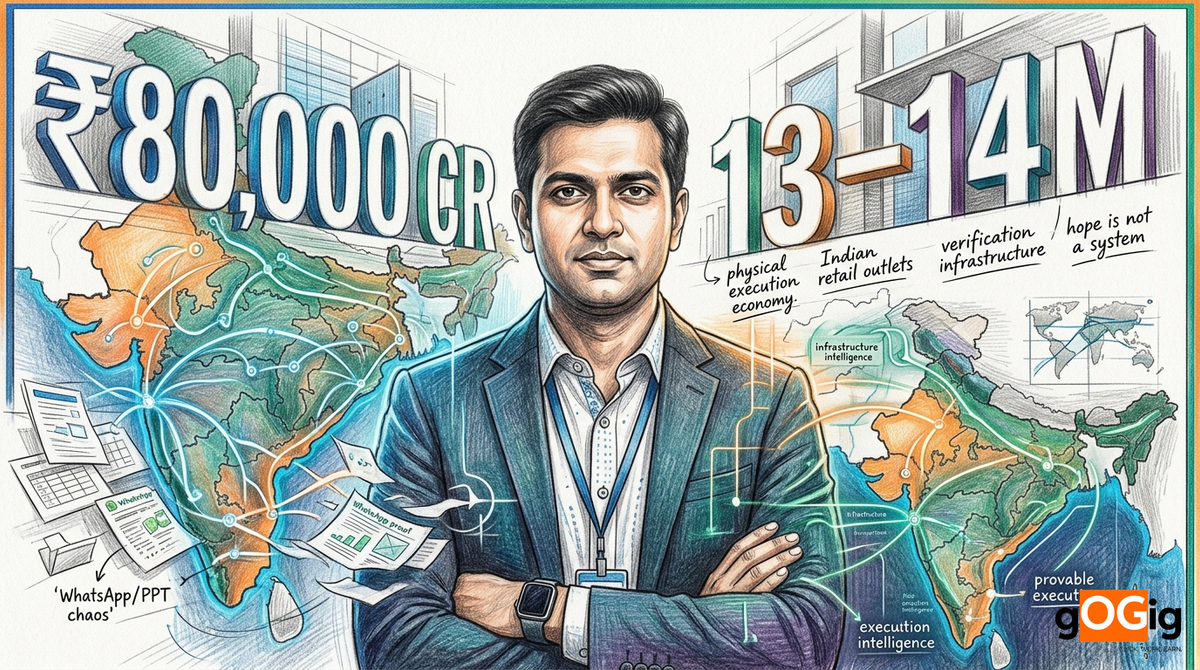
The Field Execution Intelligence manifesto: India's physical economy deserves better than hope
A category declaration from gOGig. Why India's next infrastructure layer is not another payment rail, identity stack, or commerce network. It is the verification layer for the physical economy. Built for industry, press, investors, CMOs, and anyone watching India's transition from informal physical operations to substantiable execution intelligence.
₹80,000 Cr
Size of India’s annual physical execution economy that still operates on WhatsApp, Excel, and PPT. Equivalent to roughly 1.5x of India’s annual FDI in financial services. Larger than the entire Indian print advertising market. The largest unstructured sector in India’s marketing infrastructure stack.
The contradiction defines the moment. India processes 21.7 billion UPI transactions in a single month, generates 144 crore Aadhaar identities, and operates the world's most distributed digital payment network. The same country still approves ₹80,000 Cr of annual marketing spend based on WhatsApp groups, supervisor calls, and PPT decks. Two parallel economies. One built on cryptographic trust. The other still running on hope. The manifesto is about closing that gap.
India's DPI stack: the infrastructure already built
| DPI layer | Scale (2026) | Economic impact |
|---|---|---|
| Aadhaar (identity) | 144 Cr+ IDs, 2,707 Cr authentications/year | KYC cost reduced from $20 to $0.15 |
| UPI (payments) | 21.7B transactions monthly, 81% of retail payments | ~80% of India's digital transactions |
| GST (tax visibility) | 14M+ registered businesses | B2B transaction transparency |
| DigiLocker (documents) | 30 Cr+ users | Document verification at scale |
| ONDC (commerce) | 1.16 lakh sellers, growing | Open digital commerce infrastructure |
| FASTag (mobility) | Nationwide rollout, 200M+ tags | Toll automation, vehicle tracking |
| PFMS (public finance) | ₹49.09 lakh Cr cumulative DBT transfers | ₹4.31 lakh Cr saved (ghost beneficiaries) |
| CoWIN (vaccination) | 220 Cr+ doses tracked | Public health verification at scale |
| India Stack (consolidated) | 1.4B+ Indians served | 0.9–1.3% of GDP in 2026; projected 4% by 2030 |
| DPI ROI | -- | Every $1 invested returns $3.2 to $4.0 |
The physical economy: the infrastructure layer still missing
| India physical economy indicator | Scale (2026) |
|---|---|
| Retail outlets | 13–14 million |
| FMCG field reps | 3 million+ |
| Medical representatives | 600,000+ |
| Insurance agents | 4.6 million+ |
| BFSI field force (DSA + DMA + RA) | 2.2 million+ |
| Pincodes serviced by major brands | 13,850+ |
| BTL + OOH + retail + trade annual spend | ₹80,000 Cr |
| QSR chained outlets | ~6,500+ across top 5 |
| Daily field interactions (estimated) | ~5M visits |
| Annual leakage absorbed (industry estimate) | ₹17,000–25,000 Cr |
| Verification gap baseline (gOGig Labs Q1 2026) | 22.4% |
The four pillars of the manifesto
The physical economy cannot run on assumed execution
Trust-based reporting is no longer financially viable at ₹2 lakh Cr ad market scale.
| Pillar 1 indicator | Reality |
|---|---|
| India ad market 2026 | ₹2,01,891 Cr (WPP) |
| Conservative leakage estimate (3–5%) | ₹6,000–10,000 Cr annually |
| Actual leakage observed (gOGig Labs) | 22–32% of physical spend |
| Implied true leakage | ₹17,000–25,000 Cr annually |
| Ghost activations detected | 2.8–3.4% of submissions |
| Recycled proof submissions | 3.5% exact hash match |
| Geo-spoofed check-ins | 3.8% of submissions |
| Inflated promoter hours | 4–7% of campaign cost |
Reports are not reality
A campaign report can show 96% compliance. Verified data typically shows 78%. The 18-point gap is the structural finding.
| Pillar 2 indicator | Reported vs verified |
|---|---|
| POSM compliance | 96% reported, 78–82% verified |
| Outlet coverage | 100% reported, 86–92% verified |
| Promoter attendance | 94% reported, 62–72% verified |
| Trade scheme execution | 92% reported, 74% verified |
| MR visit adherence (pharma) | 88–96% reported, 30–40% verified |
| BTL footfall (typical) | Reported, often 30–40% inflated when plausibility-tested |
| OOH illumination compliance | ~91% reported, 74% verified |
| Hygiene compliance (QSR) | 92% reported, 68% verified (pre-FEI baseline) |
Accountability is becoming infrastructure
India proved infrastructure changes behavior. UPI changed payment expectations. FEI will do the same for physical operations.
| DPI parallel | How behavior changed |
|---|---|
| Pre-UPI (2015) | Cash dominant, ~3% retail payment digitisation |
| Post-UPI (2026) | 81% retail payments via UPI, ~600M daily transactions |
| Pre-Aadhaar DBT (2014) | ~₹4.31 lakh Cr saved through ghost beneficiary elimination |
| Pre-GST (2017) | 14M+ formal businesses, B2B transaction transparency |
| Pre-FEI (today) | 22–32% physical spend leakage, audit-committee findings recurring |
| Post-FEI (projected 2030) | 4–8% leakage baseline, audit committees closing findings |
| FEI economic impact projected (2028-30) | ₹14,000–18,000 Cr annual recovery for industry |
The future competitive advantage is Ground Truth
India is still fundamentally a physical economy. The next decade belongs to organizations that know what actually happened on the ground.
| Pillar 4 indicator | Why physical-world intelligence wins |
|---|---|
| 13-14M retail outlets | Largest distributed retail network globally |
| 3M FMCG reps daily | ~5M visit logs generated daily |
| 600K MRs | One of world's largest pharma field workforces |
| 4.6M insurance agents | Most distributed financial services field force globally |
| 13,850+ pincodes | Geographic complexity unmatched elsewhere |
| 22+ regional languages in field ops | Multilingual operational intelligence required |
| Tier-3 and rural growth | Verification gap widest where supervision weakest |
| Quick commerce in 60+ cities | Real-time physical inventory becomes SLA |
Sign the Field Execution Intelligence Manifesto
Join the founders, CMOs, agency leaders, procurement heads, investors, and industry observers committing to the verification-first standard for India’s physical economy. The category begins with you.
Rs.80,000 Cr
Addressable physical economy
Rs.14-18K Cr
2030 projected recovery
Fifth pillar
DPI parallel
What Field Execution Intelligence actually defines
| FEI capability | Replaces |
|---|---|
| 9-layer mock-location detection | Single-signal GPS check-in |
| EXIF preservation + image hash uniqueness | WhatsApp photo grid |
| Server-side immutable timestamps | Client-clock dependent uploads |
| OTP confirmation for visits | Self-reported attendance |
| AI creative match (POSM, hoarding, branding) | Visual inspection of photos |
| Real-time dashboards | End-of-campaign PPT closeouts |
| Anomaly inbox | Reactive complaint-driven supervision |
| Per-vendor scorecards (A+ to D) | Subjective quarterly reviews |
| 3-way matching for BTL/OOH spend | PO + invoice match only |
| 7-year structured retention | Email folders and Google Drive |
| BRSR Core value chain disclosure | Manual annual collation |
| WhatsApp-native verified capture | App downloads and field force training |
The Blind Trust era vs the FEI era
The Blind Trust era (2010–2025)
WhatsApp + Excel + PPT as evidence. Reported compliance accepted at face value. Single-signal GPS treated as verified. Vendor self-reports treated as proof. Audit committee findings recur. Procurement teams cannot defend marketing spend. ROAS without accountability. ₹17,000–25,000 Cr leaked annually.
The FEI era (2026 onwards)
9-layer verified capture. Real-time dashboards. RoVE reported quarterly. 3-way matching standard for BTL. BRSR Core value chain ready. Per-vendor scorecards transparent. Procurement defending marketing as substantiated investment. Audit committee findings closing. ₹14,000–18,000 Cr recovered annually.
The economic case for FEI as DPI's fifth pillar
| India infrastructure layer | What it solves | Scale (2026) |
|---|---|---|
| Aadhaar | Identity verification | 144 Cr+ IDs |
| UPI | Payment infrastructure | 21.7B monthly transactions |
| GST | Tax transparency | 14M+ businesses |
| ONDC | Open commerce | 1.16 lakh sellers |
| FEI (verification) | Physical execution accountability | ~₹80,000 Cr economy addressable |
Year-on-year projection: 2026 to 2030
| Year | India ad market | FEI-covered spend | Annual recovery via FEI |
|---|---|---|---|
| 2026 | ₹2.02 lakh Cr | ~₹6,000 Cr | ~₹1,000–1,500 Cr |
| 2027 | ₹2.22 lakh Cr | ~₹14,000 Cr | ~₹2,400–3,200 Cr |
| 2028 | ₹2.44 lakh Cr | ~₹28,000 Cr | ~₹5,000–7,000 Cr |
| 2029 | ₹2.68 lakh Cr | ~₹46,000 Cr | ~₹9,000–12,000 Cr |
| 2030 | ₹2.95 lakh Cr | ~₹62,000 Cr | ~₹14,000–18,000 Cr |
Who signs the manifesto
| Signatory category | Why they sign |
|---|---|
| CMOs and Brand Managers | RoVE becomes the new accountability KPI |
| CFOs and Finance Heads | Marketing line becomes substantiable |
| Procurement Leaders | 3-way matching extends to BTL and OOH |
| Audit Committee Chairs | BRSR Core limited assurance becomes manageable |
| BTL and OOH Agency Founders | Verified by gOGig becomes premium positioning |
| Field Force Honest Performers | Productivity becomes provable |
| Vendor Operators (Tier A and A+) | Honest vendors gain market share |
| Investors and Acquirers | Verified-execution capability adds valuation premium |
| Regulators and Policymakers | Marketing spend substantiability assessable |
| Industry Researchers and Analysts | India becomes most data-rich field execution market |
| Press and Journalists | Marketing accountability becomes a recurring beat |
| Industry Associations | Sector elevates from cost-led to accountability-led |
The 8 principles of Field Execution Intelligence
| Principle | Statement |
|---|---|
| 1 | If it wasn't independently verified, it didn't happen. |
| 2 | ROAS without accountability is just optimistic math. |
| 3 | The companies that understand the physical world in real time will dominate it. |
| 4 | Reports document. Verification proves. |
| 5 | Trust is a strategy. Verification is infrastructure. |
| 6 | Honest vendors deserve provable productivity. |
| 7 | Audit committees should not need to take marketing on faith. |
| 8 | India built UPI for payments. Now we build FEI for execution. |
The category declaration
Why this manifesto matters now
| Pressure source | Effective horizon |
|---|---|
| SEBI BRSR Core mandatory top 250 | FY 2025-26 (active now) |
| BRSR Core expansion top 500 | FY 2026-27 |
| BRSR Core expansion top 1,000 | FY 2027-28 |
| RBI 2026 Loan Recovery Rules | July 2026 |
| BMC Mumbai Outdoor Advertising Policy | Notified November 2025 |
| FSSAI tightening enforcement | Continuous |
| DPDP Act 2023 enforcement | In force |
| NFRA tightening external audit standards | Continuous |
| India ad market crosses ₹2 lakh Cr | 2026 |
| Verified by gOGig procurement adoption | ~38% of top-100 by Q4 2026 |
| India DPI 2.0 (DPI@2047 roadmap) | Pilot projects 2026-27 |
What changes when the manifesto becomes operational
| Sector | Change horizon (full operational state) |
|---|---|
| BTL agencies and brand activations | 2027-28 |
| OOH agencies and DOOH operators | 2027 (BMC-led acceleration) |
| Pharma field force (MRs, DCRs) | 2028 |
| BFSI field operations (DSA, DMA, RA) | 2027 (RBI rules) |
| QSR multi-outlet networks | 2027-28 |
| FMCG retail and trade marketing | 2028-29 |
| Automotive and durables (dealer audit) | 2028-29 |
| Real estate (RERA-listed sales) | 2028-29 |
| Insurance field force | 2027-28 |
| D2C with offline expansion | 2027-29 |
What gets left behind
| Element of the Blind Trust era | What replaces it |
|---|---|
| WhatsApp groups as the primary reporting channel | WhatsApp-native verified capture pipeline |
| Excel trackers updated weekly | Real-time dashboards updated per submission |
| End-of-campaign PPT closeouts | Anytime exportable verified reports |
| Single-signal GPS check-ins | 9-layer mock-location detection |
| Photo grids in closeout decks | Per-submission audit trail with EXIF and hash |
| Subjective vendor reviews | Tier A+ to D scorecards based on VER |
| Trust-based agency relationships | Verification-based contractual partnerships |
| Did the report come? management | What actually happened? management |
| ROAS as the only ROI metric | RoVE plus ROAS |
| Audit committee findings recurring | Audit committee findings closing |
India built infrastructure for identity, payment, and tax visibility because those layers determined economic participation. The next layer determines economic substantiability. Field Execution Intelligence is not a category gOGig invented to sell a product. It is the missing rail underneath India's physical economy.
The investor case
| Investor consideration | FEI implication |
|---|---|
| Total addressable market in India | ~₹80,000 Cr physical execution economy |
| Serviceable addressable market by 2028 | ~₹28,000 to 35,000 Cr |
| Annual incremental spend (WPP, 2026) | ₹17,844 Cr |
| India advantage vs global | Physical economy scale (largest distributed retail globally) |
| Regulatory tailwinds | BRSR Core, RBI, BMC, DPDP, FSSAI alignment |
| Network effects | Verified by gOGig becomes procurement filter |
| Defensibility | 9-layer detection, 7-year retention, partner ecosystem |
| Export potential | India model replicable in Southeast Asia, Africa, Latin America |
| Public infrastructure parallel | UPI globalising (8 countries); FEI similar trajectory possible |
| Long-term GDP contribution potential | 0.1–0.3% of India GDP by 2030 |
Frequently Asked Questions
The FEI Manifesto applies across all physical execution categories in India's marketing economy.
The FEI era is operational across India's major cities and expanding to all 13,850+ pincodes.
Sign the Field Execution Intelligence Manifesto
Join the founders, CMOs, agency leaders, procurement heads, investors, and industry observers committing to the verification-first standard for India's physical economy. The category begins with you.
₹80,000 Cr
Addressable physical economy
₹14–18K Cr
2030 projected recovery
Fifth pillar
DPI parallel
Written by
gOGig Editorial
gOGig Editorial Team
gOGig is India's Field Execution Intelligence platform. Offline work. Online proof.
Was this article helpful?
Your feedback helps us write better content.