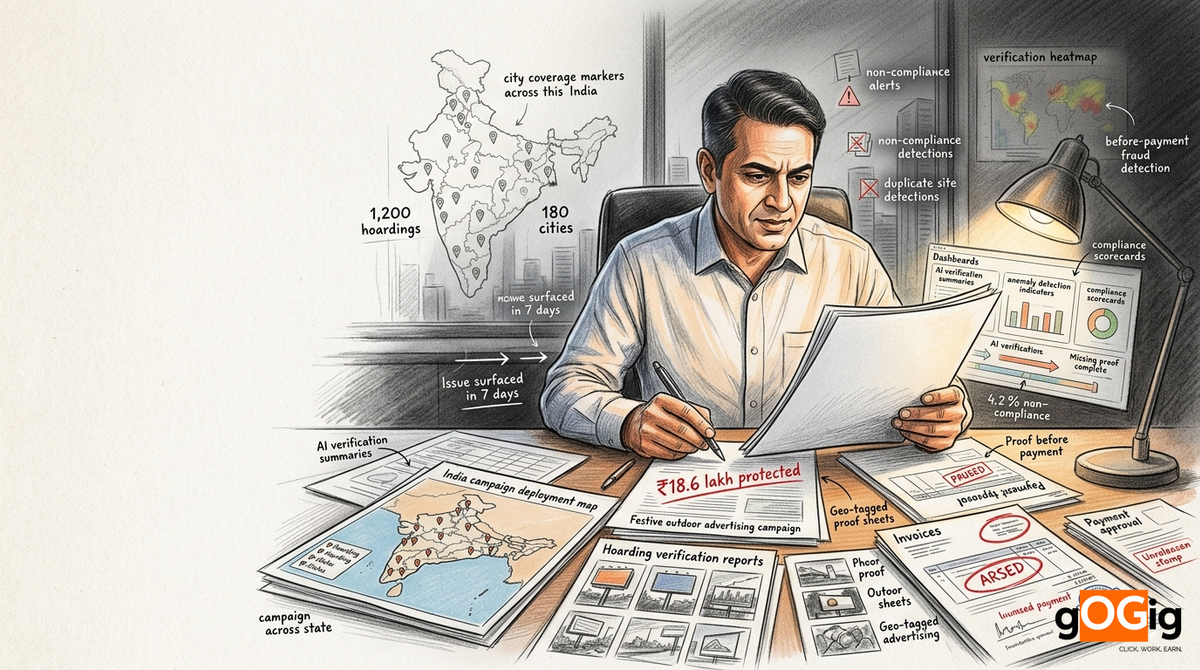
How one consumer durables brand saved Rs 18 lakh by verifying what actually happened (case study)
A top-five Indian consumer durables brand. A 1,200-hoarding festive launch across 180 cities. A 60-day deployment of Field Execution Intelligence that surfaced Rs 18.6 lakh of unverified billing before payment release. The full operational walkthrough, with named outcomes and stakeholder quotes.
₹18.6 lakh
Unverified billing surfaced and protected before payment release in a single festive OOH campaign. The case for verified BTL execution, told through one brand's experience.
The CFO opened the campaign report on day 60. Verified execution rate: 95.8%. Unverified billing flagged: ₹18.6 lakh. Variance window opened with the agency. Resolution closed within 12 business days. Payment released for ₹2.41 Cr against verified work. ₹18.6 lakh of contracted invoice never billed. The first quarter ever in which the brand could substantiate every rupee of its OOH spend.
Brand and campaign profile
| Field | Detail |
|---|---|
| Brand category | Consumer durables (top-5 Indian player, anonymised at brand request) |
| Annual ad spend | ₹110–140 Cr range |
| Annual BTL + OOH spend | ₹35–45 Cr range |
| Campaign analysed | Festive launch hoarding campaign, Sep-Dec 2025 |
| Campaign budget | ₹2.60 Cr (gross) |
| Hoardings contracted | 1,200 |
| Geographic spread | 180 cities across 28 states and UTs |
| Campaign duration | 60 days (festive window) |
| Agency partners | 2 lead agencies + 14 regional OOH vendors |
| Verification platform | gOGig Field Execution Intelligence (FEI) |
Why this campaign was selected for the pilot
| Selection criterion | This campaign |
|---|---|
| Scale and geographic spread | 1,200 hoardings, 180 cities |
| Time pressure | 60-day festive window, no margin for re-execution |
| Revenue impact of failure | Festive season = 35% of annual ad budget at risk |
| Vendor fragmentation | 14 regional OOH vendors, fragmented coverage |
| Historical pain | Brand had flagged OOH leakage internally for 3 consecutive years |
| Procurement readiness | CFO had requested 3-way matching extension to OOH |
| BRSR Core readiness | Listed entity facing FY 2025-26 limited assurance |
The starting problem in numbers
| Pain point at campaign start | Quantified status |
|---|---|
| Hoardings to be verified across 180 cities | 1,200 |
| Manual audit feasibility | 5–10% sampling at best |
| Cost of full third-party audit (traditional) | ₹14–18 lakh + 3-week timeline |
| Verification cycle under legacy workflow | 14–21 days post-install |
| Vendor self-reported compliance | 96%+ consistently |
| Independent verification before pilot | None at portfolio scale |
| Historical OOH dispute resolution time | 45–60 days |
| Estimated leak based on industry data | 3–8% of OOH spend |
| Brand's prior-year unverified spend exposure | ~₹2.8 Cr (estimated, never quantified) |
Why the brand chose to verify this campaign
| Driver | Specific concern |
|---|---|
| CFO scrutiny | Annual marketing audit raised "non-substantiable spend" finding |
| BRSR Core readiness | FY 2025-26 limited assurance approaching |
| Festive risk concentration | 35% of annual ad budget executed in 60 days |
| Previous-year dispute volume | 14 vendor disputes carried over from 2024 festive season |
| Internal audit findings | Marketing controls weakness flagged 3 years running |
| Agency relationship stress | Trust erosion with 2 of 14 vendors |
The intervention sequence
Day -14: Pre-launch alignment
Brand, agencies, and gOGig aligned on verification framework. PBP clauses added to OOH SOWs. Variance threshold set at 95% verified execution rate.
Day -7: Vendor onboarding
14 regional OOH vendors briefed on WhatsApp-based verification submission. Field installers given walkthrough of geo-tagged capture workflow.
Day 1: Campaign launch
Hoardings began going up across 180 cities. First verified submissions flowing through FEI platform within 30 minutes of first install.
Day 7: First batch of anomalies surface
4.2% of 1,200 sites flagged. 50 sites identified for re-installation or proof rework. Brand notified, vendors informed.
Day 14: Mid-campaign correction triggered
50 flagged sites either corrected or re-executed. Variance window opened with 3 vendors carrying highest anomaly concentration.
Day 30: Mid-cycle review
Verified execution rate 92.4%. Two vendors below 90% put on watch. Real-time dashboard shared with CFO for first time in brand's history.
Day 45: Final installation push
Last 8% of hoardings deployed. Verified execution rate climbed to 95.8% after corrections.
Day 60: Campaign closeout
Final report generated. 1,150 of 1,200 hoardings verified compliant. 50 still in dispute. Final invoices reconciled.
Day 72: Variance resolution closes
11 recycled photo proofs disallowed. 39 sites accepted with corrective evidence. ₹18.6 lakh held back from invoice. Payment released against verified execution.
See the full case study
Download the 24-page detailed case study including all campaign data, methodology, stakeholder quotes, and replication framework. Suitable for sharing with CFOs, audit committees, and procurement teams.
Download the full case study →The verification engine outputs
| Verification check | Submissions analysed | Anomalies flagged |
|---|---|---|
| GPS-EXIF coordinate match | 3,840 (1,200 x ~3.2 submissions each) | 192 (5.0%) |
| Server timestamp validity | 3,840 | 168 (4.4%) |
| Image hash duplicate detection | 3,840 | 11 recycled proofs identified |
| AI brand logo detection | 3,840 | 34 with wrong creative |
| AI hoarding dimensions match | 3,840 | 22 dimension mismatches |
| Geo-fence inclusion | 3,840 | 56 outside contracted zone |
| Mock-location flag | 3,840 | 14 spoofed locations |
| Image quality score | 3,840 | 89 low-quality (re-shoot requested) |
| Clustering anomaly | 3,840 | 23 suspicious co-located submissions |
| Net unique sites flagged | - | 50 of 1,200 (4.2%) |
What the 50 flagged sites broke down into
| Flag category | Sites affected | Resolution |
|---|---|---|
| Recycled photo from earlier campaign | 11 | Payment disallowed, ₹6.8 lakh held |
| Wrong creative installed | 9 | Re-installed, payment partial |
| Wrong location (off-contract) | 14 | 5 corrected on-site, 9 disallowed (₹5.4 lakh) |
| Dimensions mismatch | 8 | Re-installed or pro-rata billing |
| Low-light / poor visibility install | 5 | Re-installed |
| Damaged hoarding | 3 | Replaced |
The financial impact, line by line
| Financial line item | Original | Verified | Variance |
|---|---|---|---|
| Contracted hoardings billed | 1,200 | 1,150 | -50 |
| Gross campaign value | ₹2.60 Cr | ₹2.41 Cr | -₹18.6 lakh |
| Verified execution rate | 96% reported | 95.8% verified | 0.2% delta |
| Recycled photo disallowance | 0 | 11 sites disallowed | ₹6.8 lakh |
| Off-contract location disallowance | 0 | 9 sites disallowed | ₹5.4 lakh |
| Wrong creative correction | 0 | 9 sites pro-rated | ₹3.2 lakh |
| Dimensions mismatch correction | 0 | 8 sites pro-rated | ₹2.1 lakh |
| Damaged / poor-quality re-execution | 0 | 8 sites (8 x ₹15K) | ₹1.1 lakh |
| Total protected before payment | - | - | ₹18.6 lakh |
Stakeholder quotes
Before vs after operational comparison
2024 festive campaign (legacy)
1,200 hoardings contracted. Agency-reported execution: 96%. Independent verification: none. Payment cycle: 45–60 days. Dispute resolution: 14 unresolved into Q1 2025. Audit committee finding: open.
2025 festive campaign (FEI)
1,200 hoardings contracted. Verified execution: 95.8%. Independent verification: 3,840 submissions. Payment cycle: 12–15 days for clean vendors. Dispute resolution: closed within 72 days. Audit committee finding: closed.
Year-on-year measurable outcomes
| Metric | 2024 festive | 2025 festive (FEI) |
|---|---|---|
| Verified execution rate visibility | None | 95.8% measured |
| Anomalies detected before payment | 0 | 50 sites (4.2%) |
| Recycled photo detection | 0 | 11 instances |
| Vendor disputes carried over | 14 | 0 |
| Days from install to dispute resolution | 45–60 | 3–12 |
| Payment cycle (clean vendors) | 45–60 days | 12–15 days |
| Manual reconciliation hours | 320 hrs across brand + agency teams | 45 hrs |
| Internal audit BTL finding status | Open | Closed |
| BRSR Core substantiation | Not possible | Full 7-year trail |
| Unverified billing exposure | Unknown (estimated ₹15–25 lakh) | ₹0 (all flagged before release) |
Cost of FEI vs value protected
| Cost / value line | Amount |
|---|---|
| FEI platform cost for 60-day campaign | ₹3.8 lakh |
| Internal team hours saved | 275 hours @ ~₹2,500/hr = ₹6.9 lakh |
| Re-execution costs avoided (mid-campaign correction) | ₹4.2 lakh |
| Unverified billing protected | ₹18.6 lakh |
| Dispute carryover cost avoided | ~₹2.5 lakh (legal + admin) |
| Total quantifiable value | ₹32.2 lakh |
| Net ROI on FEI deployment | ~8.5x in 60 days |
ROI breakdown
What the audit committee saw
| Audit committee report element | Pre-FEI status | Post-FEI status |
|---|---|---|
| Marketing controls maturity score | 2 of 5 (developing) | 4 of 5 (managed) |
| BTL spend with substantiation | 0% | 95.8% |
| Open audit findings on marketing | 3 (multi-year) | 0 |
| External auditor confidence rating | Qualified | Unqualified |
| BRSR Core readiness rating | Behind schedule | On track |
| Procurement category controls | BTL excepted from 3-way match | BTL included in 3-way match |
| Quarterly board reporting depth | Agency PDF summary | Verified execution dashboard |
Vendor behaviour shift, by vendor cluster
| Vendor cluster | Pre-FEI verified rate | Day 14 | Day 60 |
|---|---|---|---|
| Top 3 vendors (high-quality) | Self-reported 95–97% | 96.4% | 97.8% |
| Mid-tier 8 vendors | Self-reported 92–96% | 91.2% | 95.4% |
| Bottom 3 vendors (high risk) | Self-reported 90–94% | 78.6% | 87.3% |
Vendor classification after the campaign
| Classification | Vendors | Outcome |
|---|---|---|
| Preferred vendor (>=95% verified) | 9 | Default for 2026 festive, premium pricing accepted |
| Standard vendor (90–94%) | 2 | Continued engagement with quarterly review |
| Watch list (85–89%) | 2 | Variance investigation, vendor improvement plan |
| Termination candidate (<85%) | 1 | Contract not renewed for 2026 |
Cross-functional impact map
| Function | Specific outcome |
|---|---|
| Marketing | Verified execution rate becomes a board-reported KPI alongside ROAS |
| Finance | BTL spend reconciliation moved from manual to automated 3-way match |
| Procurement | OOH vendors moved to PBP MSAs across 14 contracts |
| Internal audit | Marketing controls finding closed for first time in 3 years |
| ESG / sustainability | BRSR Core value chain disclosure now substantiable |
| Brand management | Festive campaign planning shifted to real-time-correctable model |
| Legal | PBP clauses adopted into standard OOH MSA template |
| Strategy | 2026 marketing plan includes verified execution targets per quarter |
The replicable playbook from this campaign
Pick the highest-stakes upcoming campaign
Festive, launch, or large multi-city activation. Pressure surfaces the value of verification faster.
Get CFO and procurement into the room early
Marketing-only buy-in produces marketing-only outcomes. CFO and procurement involvement unlocks the cross-functional value.
Set the variance threshold at 95% for OOH
Industry standard for OOH where physical install is verifiable. Tighten only if Q1 data warrants.
Brief vendors 14 days before launch
Sufficient runway for vendor field teams to learn the verification workflow without operational disruption.
Verify in real time, not at end of campaign
Day-7 anomaly surfacing is what made mid-campaign correction possible in this case study.
Use the variance window structurally
15-business-day window protects vendor procedural fairness while protecting brand cash flow.
Document outcomes for audit committee
The 32-page closeout report became the case for organisation-wide BTL FEI adoption.
Roll out to next quarter campaigns
The case study from one campaign became the foundation for the brand's 2026 marketing operating model.
What happened after the case study closed
| Post-campaign action | Outcome |
|---|---|
| Internal case study presentation to board | Board approved category-wide FEI rollout for Q1 2026 |
| Extension to retail visibility campaigns | 4,500 outlet audits / month moved to FEI |
| Extension to promoter activations | 120 mall and society activations per quarter on FEI |
| Extension to sampling drives | 15,000 outlet sampling drive on FEI in Jan-Feb 2026 |
| Extension to dealer board branding | 650 dealer locations under verified compliance |
| Vendor contract renewal cycle | All BTL MSAs updated with PBP clauses in Q1 2026 |
| Internal team training | 22 brand managers + 8 procurement team trained on dashboard |
| External communication | CFO presented case study at CFO India Summit, Feb 2026 |
Q1 2026 outcomes following the case study
| Q1 2026 metric | Brand result |
|---|---|
| Total BTL spend under FEI | 78% of category |
| Verified execution rate average | 94.6% |
| Anomalies surfaced before payment | ~2,800 across all formats |
| Total unverified billing protected | ₹68 lakh+ |
| Vendor disputes carried into Q2 | 0 |
| Procurement workflow time reduction | 62% |
| Internal audit findings on BTL | 0 open |
The first verified BTL campaign is the one that changes everything. After the brand could measure the gap, it could no longer accept it. The case for FEI made itself within 7 days.
Replicability matrix for other brand sizes
| Brand size | Estimated FEI cost for similar pilot | Expected protected value | Expected ROI |
|---|---|---|---|
| Small enterprise (₹5–15 Cr BTL) | ₹1.5–2.5 lakh | ₹5–12 lakh | 3–5x |
| Mid-size brand (₹25–75 Cr BTL) | ₹3–6 lakh | ₹18–40 lakh | 5–8x |
| Large enterprise (₹100–400 Cr BTL) | ₹8–15 lakh | ₹40 lakh–1.5 Cr | 5–12x |
| Top-tier MNC / FMCG (₹500+ Cr BTL) | ₹20–40 lakh | ₹2–5 Cr | 8–15x |
Why this campaign was not unusual
| Industry benchmark | This case | Industry typical |
|---|---|---|
| OOH non-compliance rate (1,200-site sample) | 4.2% | 3–8% (FICCI / industry estimates) |
| Recycled proof instance rate | 11 of 1,200 (0.9%) | 0.5–2% typical |
| Geo-fence violation rate | 14 of 1,200 (1.2%) | 1–3% typical |
| Mock-location use rate | 14 of 3,840 submissions (0.4%) | 0.3–1% typical |
| Image quality below threshold | 89 of 3,840 (2.3%) | 2–4% typical |
| Total billed value protected | 7.1% of campaign budget | 3–10% typical at scale |
Frequently Asked Questions
BTL and OOH formats verified through gOGig Field Execution Intelligence in this case study.
180 cities covered in this hoarding campaign across 28 states and UTs.
See the full case study
Download the 24-page case study. Includes full campaign data, methodology, all 6 stakeholder quotes, the replication matrix, and the 8-step playbook for other brands. Suitable for sharing with CFOs, audit committees, and procurement teams.
1,200 hoardings
Campaign size
₹18.6 lakh
Value protected
~8.5x
60-day ROI
Written by
gOGig Editorial
Client Success Team
The gOGig Editorial team publishes case studies, research, and operational insights from real Field Execution Intelligence deployments across India's physical economy.
Was this article helpful?
Your feedback helps us write better content.