The three sentences that will define Indian marketing accountability for the next decade
A founder manifesto from gOGig on where Indian marketing is headed between 2026 and 2036. Three sentences that compress an entire structural shift. Built for industry leaders, founders, CMOs, and anyone watching India's ₹2 lakh crore advertising economy transform from media reporting to execution intelligence.
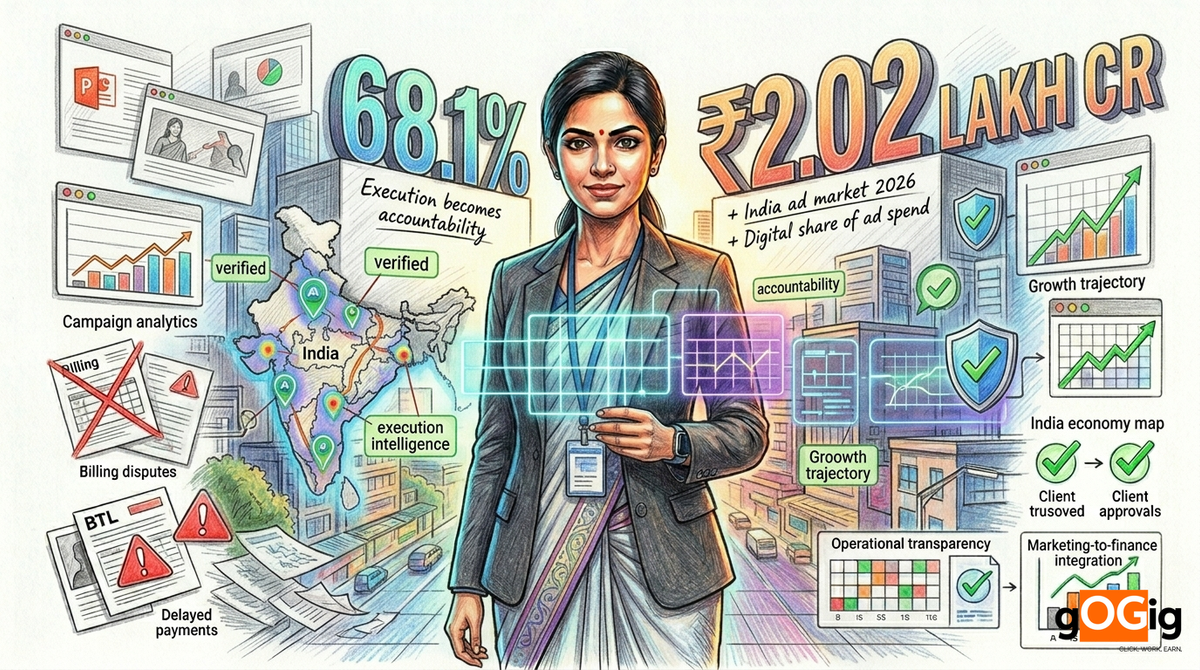
₹2.02 lakh Cr
Size of India's advertising market in 2026 per WPP TYNY. The next decade of this economy will be defined not by which channels grow fastest, but by which spend can actually be substantiated. Accountability is the structural shift hiding inside the growth story.
A note from the gOGig founder
Founder POV, May 2026
I have been watching this industry from inside the brand manager's office in 2022 to thousands of field submissions in 2026. The next ten years of Indian marketing will be decided by three sentences. Not three frameworks. Not three platforms. Three sentences that quietly rewrite what we measure, what we trust, and what we pay for.
Sentence one
If it wasn't independently verified, it didn't happen.
Why this becomes the foundational sentence
| Old assumption | New reality (2026 onwards) |
|---|---|
| "We received a report, so the campaign happened" | "Proof itself must be verifiable" |
| "The vendor sent us photos" | "The photos were EXIF-preserved and geo-locked" |
| "The agency reported 96% compliance" | "Independently verified compliance was 74%" |
| "WhatsApp images are evidence" | "WhatsApp standard mode strips EXIF and reduces resolution" |
| "Self-reporting is fine if we trust the team" | "Trust does not survive audit committee scrutiny" |
| "Verification adds friction to operations" | "Verification removes friction from payment cycles" |
| "This is how the industry has always worked" | "BRSR Core is reshaping how the industry must work" |
The supporting data for sentence one
| Indicator | Value |
|---|---|
| BTL plus OOH plus retail plus trade spend in India | ~₹80,000 Cr annually |
| Verified Execution Rate baseline (industry average) | 62 to 78% |
| Unverified spend exposure | 22 to 38% of physical marketing |
| Verified execution rate target for accountability-led brands | 92 to 96% |
| BTL submission fraud signal rate (gOGig Labs research) | 23.4% |
| BMC 2025 Advertising Policy (Mumbai) | Mandatory structural audit, insurance, blacklisting regime |
| SEBI BRSR Core mandate (top 250 listed) | FY 2025-26 limited assurance mandatory |
| DPDP Act 2023 | Consent capture for every marketing interaction |
Sentence two
ROAS without accountability is just optimistic math.
Why this sentence reframes the next decade
| The optimistic math problem | What accountability adds |
|---|---|
| ROAS assumes execution happened | VER measures whether execution actually happened |
| CAC includes inflated lead counts | Verified CAC includes OTP-validated leads only |
| Attribution is correlation, not causation | Incrementality testing separates causal lift |
| 20 to 40% of conversions would have happened anyway | True ROAS often half of reported ROAS |
| Last-click hides execution gaps | RoVE makes execution gaps visible per rupee |
| Footfall is self-reported | Footfall plausibility tested against capacity benchmarks |
| Influencer impressions accept platform metrics | Verified-engagement filters bot inflation |
| Retail compliance accepts agency PPTs | Image recognition verifies shelf reality |
The new metric stack for the next decade
| Old metric | Decade-defining metric |
|---|---|
| Impressions | Verified impressions |
| Reach | Verified reach |
| ROAS | Return on Verified Execution (RoVE) |
| CAC | Verified CAC |
| Footfall | Plausibility-tested footfall |
| Outlet coverage | OTP-validated outlet coverage |
| POSM compliance reported | POSM compliance independently verified |
| Campaign report | Verified execution report |
| Agency NPS | Procurement NPS |
| Quarterly review | Real-time anomaly inbox |
Read the Field Execution Intelligence manifesto
Apply the three-sentence framework to your 2026–2030 marketing operating model. Free 14-day pilot to baseline Verified Execution Rate across one campaign. No setup required for field teams.
Request the manifesto playbook →Sentence three
The companies that understand the physical world in real time will dominate it.
Why real-time physical intelligence becomes the moat
| India's operational complexity | Implication |
|---|---|
| 13 to 14 million retail outlets | Largest physical commerce network in the world |
| 4.6 million+ insurance and POSP agents | Most distributed financial services field force globally |
| 600,000+ medical representatives | One of the largest pharma field workforces in the world |
| 13,850+ pincodes covered by major brands | Geographic execution complexity unmatched elsewhere |
| 3 million FMCG sales reps daily | ~5 million DCRs and visit logs submitted daily |
| 22+ Indian languages in field operations | Multilingual operational intelligence required |
| Quick commerce in 60+ cities | Real-time physical inventory becomes the SLA |
| OOH inventory across 14 metros, 30+ tier-2 cities | Real-time visibility into thousands of sites |
Why this sentence creates a competitive moat
| Competitive lever | Why physical-world real-time intelligence matters |
|---|---|
| Speed of market response | Mid-campaign reallocation requires real-time visibility |
| Vendor performance optimisation | Tier classification only possible with verified data |
| Geographic targeting precision | Pincode-level execution data drives smarter expansion |
| Trade scheme effectiveness | Per-outlet, per-distributor verified execution informs spend |
| Margin defense in competitive markets | Reduced leakage protects margin under pricing pressure |
| Audit committee defensibility | Substantiable spend reduces governance overhead |
| BRSR Core value chain disclosure | Listed status requires evidence-grade infrastructure |
| Investor and acquirer confidence | Verifiable operations command premium valuation |
India's ad ecosystem entering the accountability decade
| Industry forecast source | 2026 ad market projection | Digital share projected |
|---|---|---|
| WPP TYNY 2026 | ₹2,01,891 Cr | 68.1% |
| Pitch Madison Annual Report 2026 | ₹1,74,605 Cr (expanded) | 64% |
| dentsu-e4m Digital Advertising Report 2026 | ₹1,30,416 Cr | Approaching parity |
| Commerce-led advertising growth (WPP) | 24.2% annual | Fastest segment |
| Retail media (WPP + Pitch Madison) | ₹30,000+ Cr by 2026 | ~15% of total ad revenue |
| Quick commerce ad spend | ₹4,000 Cr to ₹6,000 Cr (+50%) | High-growth digital subsegment |
| OOH and cinema (WPP) | 8.9% growth | Location-based recovery |
| Linear TV | ~₹32,855 Cr (flat) | Pricing-driven |
Where accountability matters most across this market
| Spend category | Verification risk profile |
|---|---|
| Search and social digital | Platform-verified (lower risk) |
| Programmatic display | IVT and fraud filters (medium risk) |
| Linear TV | BARC-validated (lower risk) |
| Connected TV | Platform-verified (lower risk) |
| OOH static | Highest verification gap (22 to 32%) |
| OOH digital | Play-out log verification (medium risk) |
| BTL activations | Highest fraud risk (28 to 38%) |
| Retail and trade marketing | POSM gap 22 to 32% |
| Influencer activations | Engagement inflation 14 to 28% |
| Field force and DSA | Visit adherence 30 to 40% |
The decade ahead: 2026 to 2036
| Year | Expected milestone |
|---|---|
| 2026 | BRSR Core mandatory limited assurance for top 250 listed entities |
| 2026 | RoVE vocabulary enters Indian marketing publications |
| 2026-27 | BRSR Core expands to top 500 listed entities |
| 2027 | First wave of "Verified by gOGig" certified agencies established |
| 2027 | Procurement-grade verification embedded in 30%+ of enterprise marketing contracts |
| 2027-28 | BRSR Core expands to top 1,000 listed entities |
| 2028 | First Indian-origin field execution intelligence platform reaches global scale |
| 2029 | RoVE becomes standard line item in CMO dashboard benchmarks |
| 2030 | DPI for marketing accountability becomes formal infrastructure |
| 2030 | BTL fraud rate baseline drops from 23.4% to below 8% across Indian marketing |
| 2031-33 | India becomes the global benchmark for marketing accountability infrastructure |
| 2034-36 | Field Execution Intelligence becomes a recognised global category |
What this means for each ecosystem participant
| Participant | What the three sentences mean for them |
|---|---|
| CMO | RoVE becomes the next-decade KPI. ROAS alone stops working at audit committees. |
| CFO | 3-way matching extends to BTL and OOH. Marketing line moves from cost-center to defensible-investment. |
| Chief Risk Officer | Verified vendor data closes recurring marketing controls findings. |
| Audit Committee Chair | BRSR Core limited assurance becomes routine instead of high-effort. |
| BTL agency founder | "Verified by gOGig" becomes premium pricing lever, not a checkbox. |
| OOH agency founder | Procurement integration becomes the differentiator against incumbents. |
| Field vendor | Honest vendors gain share; unverifiable vendors offboard. |
| Procurement head | BTL and OOH spend moves into governance parity with IT and logistics. |
| Investor and acquirer | Verified-execution capability becomes a valuation premium for marketing-led businesses. |
| Regulator and policymaker | Substantiability of marketing spend becomes assessable across sectors. |
| Researcher and analyst | India becomes the most data-rich market for field execution research globally. |
| Press and journalist | Marketing accountability becomes a recurring beat, not an occasional story. |
The structural forces driving these three sentences
| Structural force | Impact horizon |
|---|---|
| SEBI BRSR Core regulatory clock | Through FY 2027-28 |
| NFRA tightening audit oversight | Continuous |
| DPDP Act customer consent regime | In force |
| RBI 2026 Loan Recovery Rules | July 2026 onwards |
| BMC Mumbai Advertising Policy 2025 | City-level precedent for other metros |
| India's DPI maturation | 2.9 to 4.2% of GDP by 2030 |
| India listed company governance maturation | 2025 to 2030 |
| Global ESG and value chain transparency demand | Continuous |
| CFO pressure to substantiate marketing | 2026 onwards |
| India's per capita GDP growth driving formalisation | 0.5% to 0.7% ad share of GDP |
From media reporting to operational intelligence
The decade we are leaving
Media reporting era. WhatsApp photos, Excel sheets, end-of-quarter PPTs, agency-curated dashboards. 22 to 32% of physical marketing absorbed as execution noise. Self-reported metrics treated as evidence. ROAS without accountability accepted as proof of performance. Trust-based vendor relationships untested by audit.
The decade we are entering
Operational intelligence era. 9-layer verification, geo-locked capture, real-time anomaly inbox, vendor scorecards, 3-way matching, BRSR Core ready trails, RoVE as the new KPI. Verified Execution Rate above 92%. Independent verification as the operating standard. Marketing spend defensible at audit committee and regulator level.
In a country with 14 million retail outlets, 4.6 million insurance agents, 600,000 medical representatives, and 13,850 pincodes, the next competitive advantage is not better dashboards. It is more truth.
The cost of staying in the old decade
| Cost line | Annual exposure for a ₹5,000 Cr listed brand |
|---|---|
| BTL + OOH + retail + trade spend | ₹220 to 480 Cr |
| Verification gap absorbed (22% baseline) | ₹48 to 105 Cr |
| Recoverable through FEI Year 1 | ₹32 to 70 Cr |
| BRSR Core compliance risk (unsubstantiated value chain) | Recurring audit findings, qualified opinion risk |
| Investor and ESG analyst questioning | Continuous reputational exposure |
| Competitive disadvantage versus accountability-led peers | Hard to quantify, increasingly visible |
| Press exposure on unverifiable spend | Rising in 2026 and beyond |
| Audit committee findings recurrence | Quarter on quarter |
Frequently Asked Questions
Read the Field Execution Intelligence manifesto
Apply the three-sentence framework to your 2026–2030 marketing operating model. Free 14-day pilot to baseline Verified Execution Rate across one campaign. No setup required for field teams.
₹2.02 lakh Cr
India ad market 2026
₹80,000 Cr
Physical marketing economy
22–32%
Verification gap baseline
Written by
gOGig Editorial
gOGig Editorial Team
gOGig is India's proof-of-work layer for the physical economy. The editorial team covers field execution intelligence, marketing accountability, and BTL verification.
Was this article helpful?
Your feedback helps us write better content.