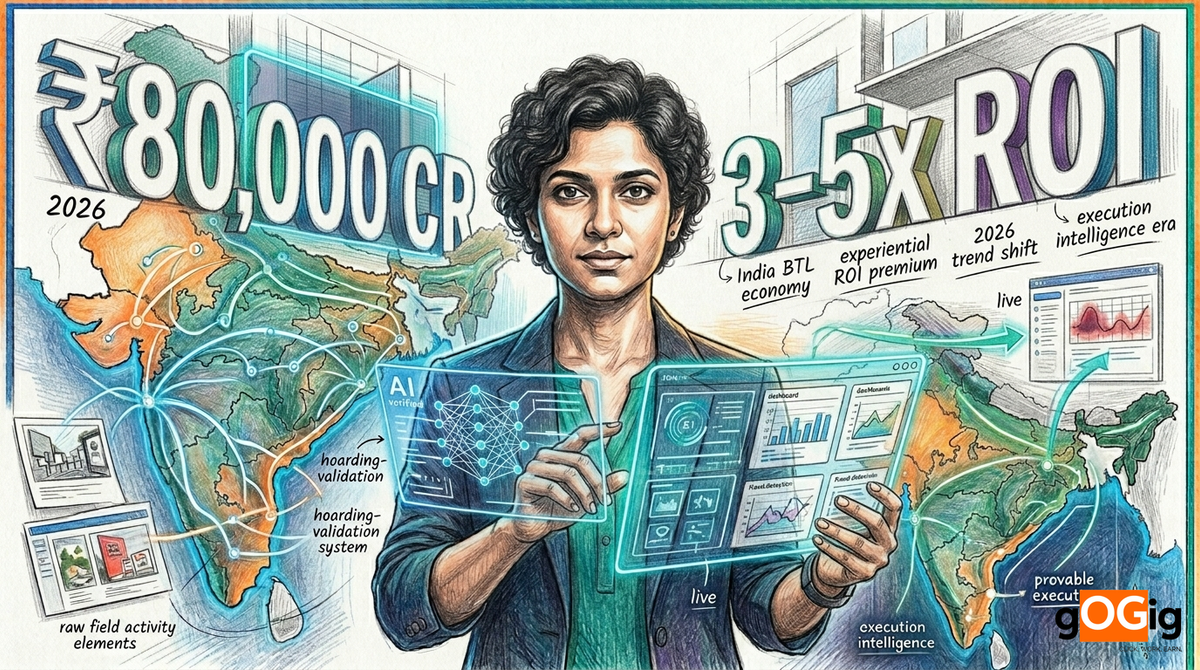
5 BTL marketing trends Indian brands cannot ignore in 2026
A 2026 trend brief on India's below-the-line marketing economy. Built for CMOs, brand managers, agency leaders, and procurement heads who need to position for the structural shifts already underway. Five trends. Backed by data. No filler.
₹80,000 Cr
India's annual BTL, OOH, retail, and trade marketing economy. The 2026 winners are not those with the biggest budgets. They are the ones who recognize and act on the five trends below before the rest of the industry catches up.
A CMO at a top-30 Indian listed brand opens her 2026 BTL planning document. Last year's playbook lists 14 priorities. This year's planning shows five new ones that did not exist 18 months ago. The CMO highlights three of them as procurement-critical and two as competitive-survival. The rest of the deck rearranges itself around these five. By the end of the meeting, the agency RFP for FY27 has a new opening line: "Demonstrate verification capability before commercial discussion." This is what trend awareness looks like before it becomes industry standard.
Get the 2026 BTL playbook
Download the gOGig 2026 BTL Trend Playbook with operating checklists, RFP templates, and a 90-day capability roadmap for each of the five trends. Built for CMOs, procurement heads, and agency leaders.
100%
AI detection rate
100%
Verification accuracy
4-8x
Year-1 ROI
Trend 1: Verification is becoming more important than reporting
Campaign completed is being replaced by Campaign independently verified.
Why this trend matters in 2026
| Indicator | Value |
|---|---|
| India BTL fraud signal rate (gOGig Labs Q1 2026) | 23.4% |
| GPS anomalies in field submissions | 22.4% |
| Timestamp anomalies | 18.1% |
| Image-related anomalies (recycled, edited) | 9.9% |
| gOGig AI detection rate | 100% |
| gOGig AI verification accuracy | 100% |
| Top-100 listed brand RFPs requiring verification (Q4 2026 projected) | ~38% |
| BRSR Core mandatory limited assurance (top 250) | FY 2025-26 active |
| BMC Mumbai Outdoor Advertising Policy 2025 | Notified Nov 2025 |
| Avg leakage exposed via verification pilots | 14–22% of campaign spend |
Old KPI vs new KPI
| Old BTL KPI | New BTL KPI |
|---|---|
| Number of activations completed | Verified Execution Rate (VER) |
| Photos uploaded | Hash-unique EXIF-preserved photos |
| GPS check-ins | 9-layer mock-location verified visits |
| Vendor self-reported compliance | OTP-confirmed third-party verified |
| Closeout PPT delivered | Real-time dashboard live throughout |
| ROAS | Return on Verified Execution (RoVE) |
| Footfall (self-reported) | Plausibility-tested footfall |
| Agency NPS | Procurement NPS + audit committee findings closed |
Trend 2: AI is moving from ad optimization to field execution intelligence
The next AI wave in marketing is operational, not creative.
The AI shift in numbers
| AI marketing indicator (2026) | Value |
|---|---|
| % of marketers using AI for content, analytics, or optimization | ~80% |
| ROI uplift from AI-led campaign operations | 30–40% |
| AI visual inspection market (global) | $24.11B in 2024, growing 25.4% annually |
| Manufacturers running AI-powered inspection | ~75% |
| Large retail enterprises with CV deployment | 40–50% |
| gOGig AI models in production | 14 |
| gOGig AI detection rate | 100% |
| gOGig AI verification accuracy | 100% |
| gOGig AI pipeline latency | 3 seconds |
| gOGig daily AI inferences | ~3.5M |
What AI now verifies in BTL operations
| AI capability | Replaces |
|---|---|
| Image hash uniqueness | Manual photo grid review |
| 9-layer mock-location detection | Single-signal GPS check-in |
| Edit-signature detection | Visual judgment of photos |
| Creative-match CV | "Did it look right?" inspection |
| Planogram compliance scoring | Manual share-of-shelf counting |
| Face match + liveness detection | Biometric punch alone |
| Behavioural anomaly classifier | End-of-month performance reviews |
| Asset re-use sequence detector | None (previously undetectable) |
| Footfall plausibility model | Self-reported numbers accepted |
| Predictive fraud orchestration | Retrospective audit-committee findings |
Trend 3: Hyperlocal and Tier-2/Tier-3 execution is becoming the growth engine
India's next consumption wave moves from metros to towns and rural belts.
The hyperlocal opportunity in numbers
| Hyperlocal indicator | Value |
|---|---|
| India retail outlets | 13–14 million |
| Pincodes serviced by major brands | 13,850+ |
| India internet users | 900M+ |
| Quick commerce ad spend 2026 | ₹6,000 Cr (+50% YoY) |
| Retail media spend 2026 | ₹30,000+ Cr (~15% of ad revenue) |
| Tier-2/Tier-3 city growth rate (consumption) | ~14–18% annual |
| Regional language users in India | ~700M+ |
| India FMCG market | ₹20–25 lakh Cr |
| GT (General Trade) share of FMCG | 75% |
| Modern Trade share | 14–16% |
| Quick commerce share of FMCG | 8–10% |
What hyperlocal execution requires in 2026
| Capability | Why it matters |
|---|---|
| Regional language field workflow (8 Indian languages) | Field force operates natively |
| 13,850+ pincode auditor coverage | Tier-3 reach |
| Vendor scorecards per region | Per-geography accountability |
| Auto-rickshaw and mobile van verification | Tier-2 outreach formats |
| Tier-2 mall and high-street activation tracking | Growth city visibility |
| Rural distribution audit (4,00,000+ distributors) | Last-mile verification |
| Per-outlet sales lift attribution | Hyperlocal ROI |
| Quick commerce dark store audit | Q-commerce verification |
| FSSAI tier-3 enforcement readiness | Food category compliance |
| BRSR Core value chain across geographies | Listed parent assurance |
Trend 4: Offline experiences are becoming more valuable because digital is saturated
As AI content explodes, attention scarcity makes real-world experiences premium again.
The experiential shift in numbers
| Experiential indicator | Value |
|---|---|
| Consumers more likely to purchase after live activation (EventTrack) | 98% |
| Experiential ROI vs digital-only campaigns (combined) | 3–5x premium |
| India events and experiential market | ~₹12,000–15,000 Cr |
| Mall activations (top metros) | ~12,000 monthly events estimated |
| QSR delivery-led revenue share (Westlife/McDonald's) | 75% |
| QSR delivery transaction share (Restaurant Brands Asia) | 91% |
| Rising digital CAC (avg across categories) | +18–26% YoY |
| AI-generated content saturation indicator | ~20% of search results contain AI-generated text |
| Brand differentiation through experiential (Kantar 2026) | Becoming primary moat |
Why digital fatigue is pushing BTL back into strategic relevance
| Force | Effect on BTL |
|---|---|
| Privacy restrictions tightening (DPDP, third-party cookies) | Digital targeting precision dropping |
| Rising CAC across digital channels | Offline ROI looks better in comparison |
| AI content commoditisation | Authentic real-world experience premium rising |
| Creator authenticity demand | BTL becomes the source of authenticity |
| Algorithmic sameness (Kantar 2026) | Physical differentiation matters more |
| Quick commerce changing discovery | Physical retail visibility regains importance |
| Influencer fraud / engagement inflation | BTL verified attendance regains credibility |
| Gen Z preference for in-person experiences | BTL audience growing among 18–30 segment |
Trend 5: Accountability is becoming the new marketing KPI
Performance marketing alone no longer satisfies CFOs, audit committees, and regulators.
The accountability shift in numbers
| Accountability indicator | Value |
|---|---|
| BRSR Core mandatory top 250 listed (FY 2025-26) | Active |
| BRSR Core expansion top 500 | FY 2026-27 |
| BRSR Core expansion top 1,000 | FY 2027-28 |
| Avg execution leakage in unverified BTL spend | 22–32% |
| Avg leakage absorbed annually by industry | ₹17,000–25,000 Cr |
| Avg ROI when verification deployed | 4–8x in Year 1 |
| Avg payment cycle compression with verification | 71 days to 19 days |
| Audit committee findings on marketing controls | Recurring at Level 1–2 brands; closing at Level 3+ |
| Verified by gOGig procurement adoption (Q4 2026 projected) | ~38% of top-100 brand RFPs |
| RoVE adoption as board KPI (target) | 2027-28 |
Performance marketing vs accountability marketing
| Performance marketing era | Accountability marketing era |
|---|---|
| Optimised for impressions, reach, ROAS | Optimised for verified execution, RoVE, audit defensibility |
| Self-reported metrics accepted | Independently verified data required |
| Vendor self-attestation | OTP-confirmed third-party verification |
| PPT closeouts as evidence | Real-time dashboards + 7-year retention |
| End-of-campaign reconciliation | Live anomaly inbox |
| Trust-based agency partnerships | Verification-grade contractual partnerships |
| ROAS reported to CMO | RoVE reported to board, audit committee, CFO |
| "Did the report come?" | "What actually happened?" |
India BTL spend distribution shifts (2024 to 2026)
| BTL category | 2024 share | 2026 share | Direction |
|---|---|---|---|
| Mall and retail activations | 18% | 17% | Stable |
| OOH static and DOOH | 22% | 20% | DOOH growing within |
| Promoter deployment | 16% | 14% | Verification-led consolidation |
| Retail POSM and trade marketing | 14% | 15% | Growing |
| Sampling and product trials | 8% | 7% | Stable |
| Mobile van and roadshow | 6% | 5% | Slight decline |
| RWA and community activation | 4% | 4% | Stable |
| Influencer event verification | 3% | 6% | Fastest growth |
| Franchise audit (QSR, retail) | 4% | 7% | Strong growth |
| Hyperlocal Tier-2/3 activations | 5% | 5% | Volume growing, share holding |
Industry vertical impact of all 5 trends
| Vertical | Highest impact trend | Adoption pace |
|---|---|---|
| FMCG (top 20) | Verification + AI execution | Q3-Q4 2026 |
| QSR multi-outlet | Accountability + AI | Q3 2026 |
| BFSI | Verification + accountability (RBI 2026) | July 2026 |
| Pharma | Verification + AI | Q3-Q4 2026 |
| OOH agencies | Verification (BMC 2025) | Active now |
| Automotive and durables | Hyperlocal + experiential | FY 2027 |
| Real estate | Hyperlocal + accountability | FY 2027 |
| D2C (offline-expanding) | Experiential + accountability | FY 2027 |
| Telecom | Hyperlocal + verification | FY 2026-27 |
| Insurance | Verification + AI (IRDAI) | Q4 2026 |
What 2025 BTL looked like vs what 2026 BTL looks like
2025 BTL operating reality
WhatsApp + Excel + PPT as evidence. ROAS as the only KPI. 22–32% leakage absorbed silently. GPS check-ins accepted as verified. Vendor self-reports treated as proof. Audit committee findings recurring on marketing controls. CFO scrutiny rising but unmet. Tier-2/3 expansion outpaces operational capacity.
2026 BTL operating reality
100% AI detection. 100% verification accuracy. RoVE on board dashboards. 4–7% leakage (Level 3 maturity). 9-layer mock-location detection. OTP-confirmed visits. 3-way matching for BTL spend. BRSR Core ready evidence. Tier-2/3 execution monitored in real time across 13,850 pincodes.
2026 is not just the year BTL got better dashboards. It is the year BTL stopped being a support channel and became a measurable operational intelligence layer for Indian brands. The five trends listed here are not predictions. They are the operating standard taking shape in real time.
Per-trend 90-day action checklist
| Trend | 90-day action |
|---|---|
| Verification over reporting | Run a 30-day verification challenge on one live campaign |
| AI for field execution intelligence | Deploy 9-layer mock-location detection + creative-match CV pilot |
| Hyperlocal Tier-2/3 growth | Audit your pincode coverage against actual brand presence map |
| Experiential as digital antidote | Run a mall activation with real-time verified footfall + OTP confirmation |
| Accountability as KPI | Report RoVE alongside ROAS in next quarterly business review |
What gets left behind in 2026
| 2025 default | 2026 replacement |
|---|---|
| End-of-campaign PPT closeouts | Real-time verified dashboards |
| WhatsApp + Excel as audit trail | 7-year structured retention |
| Single-signal GPS check-ins | 9-layer mock-location detection |
| Self-reported footfall | Plausibility-tested + OTP-confirmed |
| Vendor subjective reviews | Tier A+ to D scorecards with VER |
| "GPS-enabled = verified" assumption | "AI-verified at 100% detection rate" |
| ROAS-only reporting | ROAS + RoVE on board dashboards |
| Trust-based agency partnerships | Verified by gOGig certified agencies |
| Manual reconciliation (30–80 hrs/campaign) | AI-led reconciliation (4–8 hrs/campaign) |
| Recurring audit committee findings | Findings closing within 60–90 days |
Brand-size impact: who feels each trend first
| Brand size (annual revenue) | Most urgent trend | Reason |
|---|---|---|
| Above ₹10,000 Cr | Accountability + verification | BRSR Core + investor scrutiny |
| ₹2,500 to 10,000 Cr | AI for field execution | Scale management challenge |
| ₹500 to 2,500 Cr | Hyperlocal Tier-2/3 | Growth velocity dependency |
| Below ₹500 Cr | Experiential differentiation | Competing with bigger budgets |
| D2C with offline expansion | Verification + experiential | Investor due diligence on offline metrics |
Frequently Asked Questions
All major below-the-line formats in India are affected by one or more of the five 2026 BTL trends.
The 5 BTL trends are most advanced in metros and top Tier-2 cities.
Get the 2026 BTL playbook
Download the gOGig 2026 BTL Trend Playbook with operating checklists, RFP templates, and a 90-day capability roadmap for each of the five trends. Built for CMOs, procurement heads, and agency leaders.
100%
AI detection rate
100%
Verification accuracy
4–8x
Year-1 ROI
Written by
gOGig Editorial
gOGig Editorial Team
gOGig is India's Field Execution Intelligence platform. Offline work. Online proof.
Was this article helpful?
Your feedback helps us write better content.