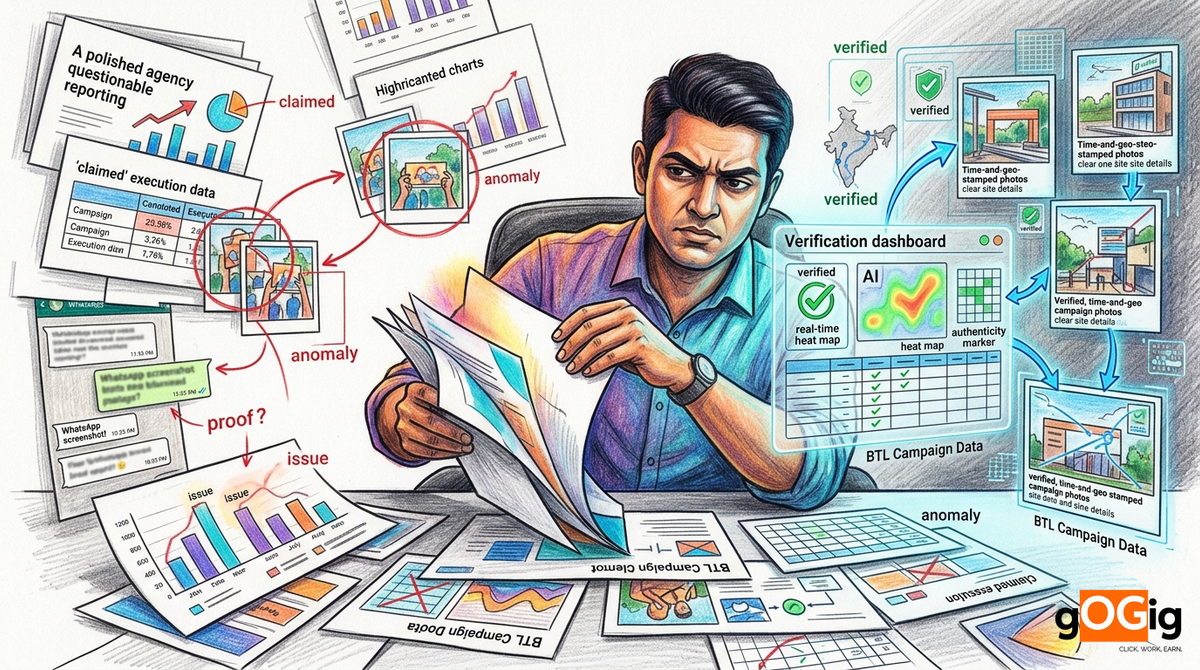
Why your BTL agency's report is not proof (and what real verification looks like)
A forensic walkthrough of the 40-slide BTL closeout PPT, line by line. What the report shows. What it doesn't show. What real verification replaces it with. Built for brand managers and procurement teams who keep hearing "our agencies already give us reports."
0%
Independent verification in a standard BTL agency report. The party being paid writes the report on the work. This is not proof. It is a claim.
At 4:47 PM on a Friday, the brand manager receives a 47-slide PowerPoint deck. "Q1 BTL Campaign Closeout Report." 142 photos. ROI math. Footfall claims. Lead totals. Compliance certifications. The deck looks credible. None of it is verified by anyone other than the party requesting payment.
What's inside a typical BTL agency closeout PPT
| Slide type | Typical count | What it claims to prove |
|---|---|---|
| Executive summary | 1–2 | Campaign hit objectives |
| Campaign overview & scope | 2–3 | What was planned |
| City coverage map | 1–2 | Geographic reach |
| Activation calendar | 1–2 | Schedule adherence |
| Photo grids (mall activations) | 8–12 | Activations happened |
| Photo grids (RWA / society) | 6–10 | Society events occurred |
| Photo grids (retail visibility) | 4–8 | Outlets covered |
| Photo grids (sampling drives) | 4–6 | Samples distributed |
| Footfall & engagement metrics | 3–5 | Audience reach |
| Lead capture summary | 2–3 | Lead volume |
| "Voice of customer" testimonials | 1–2 | Audience sentiment |
| Compliance certifications | 1–2 | Legal completeness |
| ROI math summary | 1–2 | Financial return |
| Next steps / recommendations | 1–2 | Continuity ask |
| Total typical PPT length | 38–52 slides | -- |
Claim vs evidence: what the PPT proves and what it doesn't
| Agency report claim | What it proves | What it doesn't prove |
|---|---|---|
| "Campaign executed across 20 cities" | A list of city names was typed | That activations actually happened in those cities |
| "500 hoardings installed" | Number was reported | That all 500 sites are physically active |
| "5,000 promoter hours deployed" | Attendance sheet was generated | That 5,000 actual hours were worked by named people |
| "96% execution rate" | A percentage was calculated | That 96% is independently verifiable |
| "GPS-tagged proof of activation" | Photos were submitted | That photos were taken at contracted locations |
| "840 leads captured" | An Excel sheet exists | That the leads are real phone numbers that answer |
| "All POSM installed" | Claim was made in the PPT | That POSM materials physically reached outlets |
| "7,500 samples distributed" | Distribution claim was made | Where the 313 missing samples actually went |
| "60,000 footfall" | A number was estimated | That 60,000 people physically attended |
| "Legal compliance certified" | Certificate was attached | That every site has permission paperwork |
The 12 forgery patterns inside a typical BTL closeout PPT
Recycled photo from prior campaign
Same photo from earlier campaign appears under a new caption. WhatsApp transport strips the EXIF that would expose it.
30 sec
Time to fabricate
Stock photo dropped into slide
"Crowd shot" or "consumer engagement" image lifted from stock photo sites. Brand manager sees consumer faces, assumes attendance.
2 min
Time to fabricate
Same hoarding photographed from 5 angles
One physical hoarding becomes 5 reported installs across the slide deck. No image hash check exposes the duplication.
5 min
Time to fabricate
Inflated footfall estimates
"60,000 footfall" with no independently captured counter. Mall capacity, weather, foot-traffic baselines never validated.
10 sec
Time to fabricate
Fabricated leads in Excel attachment
Random names + sequenced phone numbers added to lead list. Brand discovers fakes weeks later during first-call follow-up.
15 min for 100 leads
Time to fabricate
Pre-dated photo submission
Photo taken weeks ago, captioned as a current campaign moment. Server-side timestamp absent; receiver has no way to verify.
2 min
Time to fabricate
Same backdrop across multiple "cities"
Three different "city activations" use the same wall, same banner pattern, same lighting. Image similarity check would flag it; PPT review does not.
N/A (already present)
Time to fabricate
Attendance roster with borrowed names
Names lifted from prior campaign attendance sheets. Brand manager never cross-checks against payroll records.
5 min
Time to fabricate
Compliance certificate without timestamp
PDF certificate attached without independent verifier signature, GST, or contact details. Hard to validate authenticity.
3 min
Time to fabricate
ROI math with no underlying data
"₹12 Cr brand value generated from ₹1 Cr spent." Calculation methodology absent from the deck. Unfalsifiable claim.
10 min
Time to fabricate
Selective photo curation
Only the photos that show success make it into the deck. Failed sites, empty activations, low-footfall hours never appear.
20 min of curation
Time to fabricate
"Voice of customer" testimonials
Quotes without speaker names, captures, audio recordings, or release forms. Sometimes typed by the agency for the slide.
8 min
Time to fabricate
What's missing from a typical agency report
| Data point | Present in PPT? | Required for verification? |
|---|---|---|
| Server-side timestamp on each photo | No | Yes |
| GPS coordinates with each photo | Inconsistent | Yes |
| EXIF metadata intact | No (WhatsApp strips it) | Yes |
| Image hash uniqueness check | No | Yes |
| Mock-location flag check | No | Yes |
| Geo-fence inclusion verification | No | Yes |
| Device integrity attestation | No | Yes |
| Cross-campaign duplicate flag | No | Yes |
| OTP-verified lead validity | No | Yes (for lead capture) |
| Independent third-party verifier | No (self-reported) | Yes |
| Audit trail with chain of custody | No | Yes |
| Variance window evidence | No | Yes |
| Per-vendor verified execution rate | No | Yes |
| BRSR Core-aligned 7-year retention | No (PPT shared, not retained as evidence) | Yes for listed companies |
| Procurement 3-way match readiness | No | Yes |
Side by side: agency PPT slide vs verified proof record
| Element | Agency PPT slide | Verified proof record |
|---|---|---|
| Photo source | Curated by agency | Captured at submission, server-timestamped |
| GPS data | Implicit / claimed | EXIF-extracted, cross-checked with EXIF |
| Timestamp | Set by agency in caption | Server-side, immutable |
| Identity of photographer | Unspecified | Vendor / device ID logged |
| Image uniqueness | Not checked | SHA-256 hash against full dataset |
| Mock-location detection | Absent | 9-layer detection (99%+) |
| Geo-fence check | Implicit | Pass/fail per submission |
| Lead validation | Phone number listed | OTP verified at capture |
| Audit trail | None | 7-year retention, chain of custody |
| Independent verifier | Same party as executor | Platform-level, independent |
| Real-time visibility | End-of-campaign PPT | Submission visible in 3 seconds |
| Vendor-level breakdown | Aggregated, no vendor-level | Per-vendor verified execution rate |
| Anomaly surfacing | None | Real-time anomaly inbox |
| BRSR Core readiness | Insufficient | Full alignment |
| Procurement 3-way match | Excepted | Standard |
Send us your most recent BTL closeout PPT.
We will produce a side-by-side audit showing what the report proves, what it doesn't, and what verified proof would look like for the same campaign. Free, 5 business days.
Request a free side-by-side audit →The structural conflict of interest in agency reporting
No other category of corporate spend tolerates a structure where the same party writes the report, curates the evidence, sets the timeline, signs the compliance certificate, and submits the invoice. BTL is the last category in Indian B2B where this is normal.
| Conflict layer | Why it matters |
|---|---|
| The party writing the report is being paid by the report | Same as a vendor self-certifying delivery for invoice approval |
| The party curating photos chooses which photos to share | No mechanism to surface what wasn't shared |
| The party setting timestamps controls the timeline narrative | "When the campaign happened" is the agency's claim |
| The party reporting attendance also pays the attendees | Names on the sheet can be names on the payroll, or not |
| The party reporting compliance also produced the certificate | Self-issued certificate is not independent assurance |
| The party reporting ROI also benefits from showing high ROI | Methodology absence is convenient for the reporter |
What "real verification" actually looks like in 2026
| Verification element | Real verification looks like |
|---|---|
| Photo capture | Captured at submission, server-timestamped, EXIF-intact |
| Location | GPS + EXIF + Wi-Fi + cell tower triangulation |
| Time | Server-side immutable timestamp |
| Identity | Device fingerprint + vendor mapping + selfie verification |
| Image authenticity | SHA-256 hash against full historical dataset |
| Device integrity | 9-layer mock-location detection |
| Activity duration | Continuous capture across activity window |
| Movement | Accelerometer + gyroscope cross-check |
| Lead validity | OTP-verified phone number at capture |
| Attendance | Cross-checked against vendor payroll records |
| Independent verifier | Platform-level, separate from executor |
| Audit trail | 7-year retention, immutable, BRSR Core aligned |
| Anomaly surfacing | Real-time inbox, not end-of-campaign PPT |
| Variance handling | 15-business-day window for vendor evidence |
| Procurement integration | 3-way matching ready (PO + invoice + verification) |
The four questions agency reports cannot answer
| Question | Why agency reports fail to answer |
|---|---|
| Did the activation actually happen? | No independent capture; only agency-curated photos |
| Was it executed for the required duration? | Photo clusters at start/end, gap in middle invisible |
| Was the store / venue actually active? | No outlet status verification |
| Should this invoice actually be paid? | No 3-way matching evidence in the deck |
What verified proof answers about the same campaign
| Verification answer | Source signal |
|---|---|
| "Activation occurred at GPS coordinate X, in 95.8% of contracted sites" | GPS + EXIF + geo-fence verified |
| "Activation ran for 3 hours 47 minutes of contracted 4 hours" | Continuous capture, accelerometer logs |
| "Outlet was active in 1,950 of 2,500 contracted touches" | OTP verification + outlet status check |
| "Invoice eligibility: ₹2.41 Cr verified of ₹2.60 Cr billed" | 3-way matching report |
Agency report vs verified proof: cost and time comparison
| Operational metric | Agency PPT report | FEI verified proof |
|---|---|---|
| Production cost | ₹40K-1.5 L per campaign closeout | ₹3–15 / submission (platform fee) |
| Production time | 1–3 weeks post-campaign | Continuous (3 sec / submission) |
| Information freshness | End of campaign | Real-time |
| Anomaly detection | Often never | At submission |
| Vendor accountability | End-of-campaign blame allocation | Mid-campaign correction |
| Audit-grade defensibility | Weak (self-reported) | Strong (multi-signal, third-party) |
| Procurement match-readiness | Manual reconciliation required | Automatic 3-way matching |
| BRSR Core fit | Insufficient | Full alignment, 7-year retention |
| Reusable in next quarter's planning | Limited | Vendor-level performance baseline |
Procurement test matrix: what passes 3-way matching
| Procurement test | Agency PPT report | FEI verified proof |
|---|---|---|
| Purchase Order match | Yes | Yes |
| Invoice match | Yes | Yes |
| Goods Receipt Note / Delivery Confirmation | Self-reported by executor | Independently verified |
| Independent evidence | Absent | Present (platform) |
| Audit trail with chain of custody | Absent | Present |
| Variance handling protocol | Ad-hoc | Structured 15-day window |
| BRSR Core 7-year retention | Inconsistent | Default |
| Re-verifiable on future audit | No | Yes |
| Verdict | Fails standard 3-way match | Passes 3-way match |
Why brand managers keep accepting agency reports
| Acceptance driver | Implicit assumption |
|---|---|
| "We've worked with this agency for years" | Trust = verification |
| "The photos look real" | Visual plausibility = proof |
| "The agency has reputation" | Brand name = quality control |
| "96% execution rate looks fine" | Reported number = verified number |
| "They've never been caught" | Absence of evidence = evidence of absence |
| "Verification is too expensive" | Not true: ROI typically 4–8x in 60 days |
| "Independent audit takes weeks" | True for legacy audit firms; not for FEI |
| "We don't have a category for this" | True until 2024; FEI category now exists |
The agency vs FEI relationship (it is not adversarial)
| Relationship dimension | Mistaken assumption | Reality with FEI |
|---|---|---|
| Agency role | "FEI replaces our agency" | Agency continues all creative + operational work |
| Agency reporting | "Agency will stop sending reports" | Agency reports continue; FEI adds independent verification layer |
| Agency margin | "FEI compresses agency profits" | Honest agencies benefit from faster payments + clearer differentiation |
| Agency vendor pool | "FEI cuts agency vendor network" | Honest vendors retained; spoofing-dependent vendors filtered out |
| Brand-agency relationship | "Verification damages trust" | Verification removes ambiguity and strengthens long-term relationships |
| Procurement relationship | "Verification adds bureaucracy" | 3-way matching becomes automatic, reducing manual reconciliation |
The 30-day shift from PPT to verified proof
| Stage | Duration | Outcome |
|---|---|---|
| Pre-launch alignment | 2–3 days | FEI added to ongoing agency workflow |
| Day 1–3: Vendor onboarding | 3 days | WhatsApp-based capture live, vendors trained |
| Day 4–10: First verified submissions | 1 week | Real-time dashboard live for brand manager |
| Day 11–20: Mid-cycle anomaly surfacing | 10 days | Anomalies caught, variance window opened |
| Day 21–30: Closeout reconciliation | 10 days | Verified proof report vs agency PPT comparison |
| Day 30: Side-by-side outcome shared with CFO | 1 day | First substantiable BTL closeout in brand's history |
Replacing the closeout PPT with verified proof
Legacy approach
47-slide PPT generated by agency. 142 curated photos. ROI math without methodology. Compliance certificates self-issued. Voice-of-customer testimonials typed by agency. End-of-campaign delivery 2–3 weeks after close. No procurement match readiness.
FEI approach
Real-time dashboard. Per-submission audit trail with chain of custody. Verified execution rate per vendor, per city, per format. Anomaly inbox with response status. 7-year retention. Procurement-ready 3-way matching reports. CFO and audit committee defensible.
What replaces each PPT slide
| Agency PPT slide | FEI replacement |
|---|---|
| Photo grid (mall activations) | Per-activation verified record with GPS, timestamp, duration, anomaly status |
| Photo grid (RWA / society) | Geo-fenced verification + OTP-validated lead capture |
| Photo grid (retail visibility) | Outlet-level verified compliance score |
| Photo grid (sampling drives) | Sample stock reconciliation + outlet distribution log |
| Footfall & engagement metrics | Verified footfall via capacity check + multi-signal cross-reference |
| Lead capture summary | OTP-verified lead count + first-call validity rate |
| Voice-of-customer testimonials | Recorded customer responses with audio capture + consent |
| Compliance certifications | Independent platform-level certification + 7-year retention |
| ROI math summary | Verified spend vs verified execution, methodology disclosed |
| Next steps / recommendations | Vendor-level performance scorecard for next quarter |
A timestamped image in a vendor PPT is not evidence. It is an unverified claim. The shift from reporting to verification is the difference between reading what someone said happened and proving what actually happened.
Specific objections (and the answers)
| Objection | Answer |
|---|---|
| "Our agencies already give us reports." | Reports are claims. Verification is proof. Different categories. |
| "This will damage our agency relationship." | Honest agencies welcome it (faster payment cycles). Pushback is data. |
| "This adds cost to our marketing operations." | Platform cost typically 1–3% of BTL spend. ROI 4–8x in 60 days. |
| "Our agency is too sophisticated to fabricate." | Sophistication isn't the issue. Structural conflict of interest is. |
| "Our procurement is already tough enough." | FEI automates 3-way matching. Procurement workload drops, not rises. |
| "We don't have time to roll out a new platform." | 30 days to first campaign closeout. WhatsApp-native. No new tools for vendors. |
| "BRSR doesn't apply to us yet." | BRSR Core covers top 250 listed FY 2025-26; expanding to top 1,000 by FY 2026-27. |
| "Verification will slow down our campaigns." | Verification runs in parallel. 3-second per submission, no operational impact. |
| "Our CFO is fine with current reporting." | The CFO who sees verified data first cannot return to PPT reports. |
| "Other brands aren't doing this." | 32+ enterprise brands on FEI in 2026. Category leader adoption is accelerating. |
What gets reported vs what gets verified across campaign types
| Campaign type | What agency report claims | What FEI verifies |
|---|---|---|
| OOH hoardings | "500 hoardings installed" | Per-site geo + image hash + dimensions verified |
| Wall painting | "30,000 sq ft completed" | Per-site before/after + GPS + measurement |
| Mobile van routes | "40 days, 12 cities" | Per-stop GPS trail + activity duration |
| Mall activations | "15 mall days, 60,000 footfall" | Per-day check-in/out + footfall plausibility check |
| Promoter deployments | "5,000 promoter hours" | Per-promoter selfie + geo-fenced attendance + payroll match |
| RWA / society activation | "200 events executed" | Per-event setup verification + lead OTP + duration capture |
| Sampling drives | "60,000 samples distributed" | Per-outlet sample reconciliation + drive route check |
| Lead generation | "840 leads captured" | OTP-validated leads + first-call validity |
| Retail visibility audits | "2,500 outlets touched" | Per-outlet visit + planogram compliance score |
| Trade scheme support | "All POSM installed" | Per-POSM installation evidence + dealer attestation |
The 8 KPIs that replace agency report metrics
| Legacy agency metric | FEI verified KPI |
|---|---|
| "Campaigns executed" | Verified execution rate (%) |
| "Cities covered" | Cities with verified anomaly rate <15% |
| "Footfall achieved" | Plausibility-checked footfall |
| "Promoter hours deployed" | Verified promoter hours (payroll-matched) |
| "Leads captured" | OTP-verified leads + first-call validity rate |
| "Photos submitted" | Hash-unique submissions, EXIF-intact |
| "On-time execution" | Real-time milestone tracking |
| "ROI claimed" | Verified spend / verified execution ratio |
Year-on-year shift in the verification standard
| Period | Industry standard | Brand expectations |
|---|---|---|
| Pre-2023 | Agency PPT with photos | "Did we receive the report?" |
| 2024–2025 | PPT + selective audit sampling | "Are some sites verified?" |
| 2026 | Real-time FEI dashboards emerging | "What was the verified execution rate?" |
| 2027 | FEI becoming default for top 1,000 listed | "Show me the per-vendor verified rate" |
| 2028+ | Procurement-grade verification mandatory | "Why isn't every rupee verified?" |
Frequently Asked Questions
Compare an agency report vs verified proof
Send us your most recent BTL closeout PPT. We will produce a side-by-side audit showing what the report proves, what it doesn't, and what verified proof for the same campaign would look like. Free, 5 business days, no commitment.
38–52
Agency PPT slides
< 5%
Verifiable data points
100%
FEI verified data points
Written by
gOGig Editorial
Platform Education Team
The gOGig Editorial team publishes platform education content, procurement guides, and verification standards for brand managers and procurement teams in India's physical economy.
Was this article helpful?
Your feedback helps us write better content.