gOGig vs PPT-based campaign reporting: which actually works in 2026
2 min read

A practical 2026 buyer guide for brand audit heads, procurement directors, BTL operations leads, OOH marketing managers, and finance teams evaluating verification partners for high-volume offline campaigns. Built around the 7 architectural differences between sampling-based audit agencies and task-level Field Execution Intelligence (FEI), with honest treatment of where each model fits best.
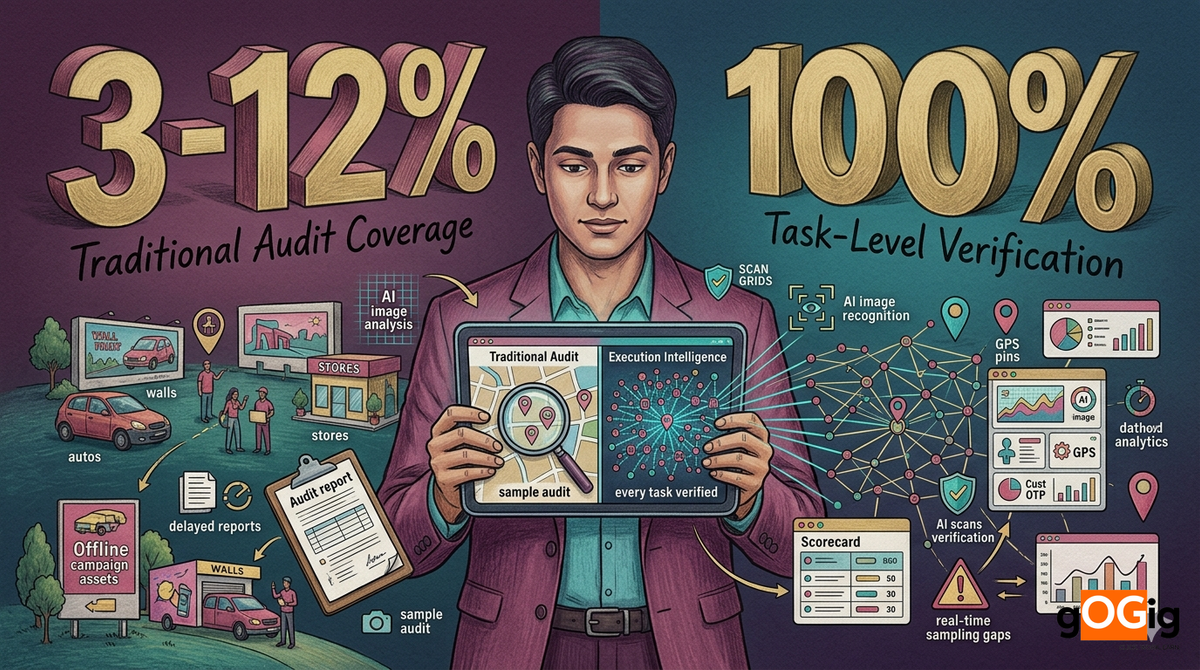
3-12%
Typical sample size of a traditional BTL audit agency's verification coverage. A sample-based audit reports on the slice it inspects; it cannot independently verify the remaining 88-97% of the campaign. That model works for OOH site quality, pre-acquisition feasibility, and post-campaign visibility checks. At task-level scale (5,000 retail outlets, 2,000 autos, 10,000 wall paintings, 500 promoters), the gap between sample-based and task-level verification is the entire conversation.
A national paint brand is finalising its FY27 verification partner. Two proposals on the procurement table. Proposal A is from a leading OOH + BTL audit agency: physical field auditor network across 86 cities, geotagged photo collection, post-campaign reports with case studies. ₹38 L for the year. Proposal B is from gOGig: every execution event (5,200 retail outlets, 2,400 autos, 11,800 wall paintings, 720 promoters) verified at task level through AI image + 9-layer mock-location + customer OTP + photogrammetry + per-vendor scorecards, plus real-time multi-city dashboard. ₹72 L for the year. The CFO asks: "Why the gap?" The answer is not "feature parity at different price points". It is "the two products solve different problems". Proposal A verifies a sample of the campaign exists. Proposal B verifies every event in the campaign happened. The choice depends on which problem the brand is trying to solve. Both have legitimate use cases.
| Where traditional audit agencies excel | Why they are the right choice |
|---|---|
| OOH site quality inspection (hoardings, gantries, bus shelters) | Physical inspection of structure, lighting, lamination, tear / damage |
| Pre-acquisition site feasibility surveys | Field auditors assess footfall, visibility angle, illumination potential |
| Post-campaign visibility reports (cinematographic-style) | Curated visual storytelling for boardroom presentations |
| Media quality benchmarking | Cross-vendor comparison of lamination quality, mounting, finish |
| Compliance certificates (legal / municipal) | Documented evidence for regulatory authorities |
| Election / political campaign auditing | Independent third-party for politically sensitive verification |
| Limited-asset campaigns (≤500 assets total) | Manual sampling viable at low volumes |
| Premium asset audits (airport, metro, premium billboards) | Specialist expertise in high-value media |
| Statutory media compliance audits | Documented evidence for SEBI / CAG / state regulator review |
| Forensic post-event investigations | Deep dive into specific suspicious events |
Traditional audit agencies (OOHAudit, Top Hawks Verify, Hashbrown Systems, SGS-India audit, and specialised regional partners) deliver real value in these specific scenarios. The question is not "is one better than the other?". The question is "what is the right tool for the campaign?".
Verification timing: after execution vs during execution
Traditional audit reports arrive 5-21 days after the campaign. By the time corrective action can be taken, the campaign is often over.
Traditional audit agency
Field auditor visits a sample of sites. Reports compiled into post-campaign PPT/PDF. Delivery 5-21 days after campaign closeout. Errors discovered late; budget already spent.
gOGig (FEI)
Every execution event AI-verified at the moment of submission. Real-time alerts during campaign. Errors detected within minutes; corrective action possible while campaign is live.
Coverage model: sample-based vs task-level
Traditional agencies verify 3-12% of campaign through audit visits. gOGig verifies every single execution event through software.
Traditional audit agency
100 site visits across a 1,000-asset campaign. Sample inferences extrapolated. Per-asset accountability impossible for non-sampled 900 assets. Coverage % is statistical estimate.
gOGig (FEI)
All 1,000 assets verified at task level. Per-asset audit trail. Per-vendor accountability per asset. Coverage % is calculated reality, not extrapolation.
Verification source: human auditor vs verification engine
Traditional agencies depend on field auditors visiting sites. gOGig uses 14 AI models that verify every submission automatically.
Traditional audit agency
Field auditor network (50-200 auditors per firm). Auditor coordination, scheduling, route planning. Human judgment on each site. Subject to fatigue, geographic limits, and audit-the-auditor risk.
gOGig (FEI)
Verification engines: SHA-256 + perceptual hash + edit-signature CV, 9-layer mock-location detection, face-match CNN, AI photogrammetry, route reconstruction. Automated. Network-scale. Consistent across all submissions.
Deliverable: report vs operational telemetry
Traditional agencies produce reports that tell you what happened. gOGig produces telemetry that tells you what is happening.
Traditional audit agency
PDF reports. PPT decks. Audit summaries. Curated photographs. Case studies. Visual storytelling. Delivery typically weekly or end-of-campaign. Backward-looking by design.
gOGig (FEI)
Live dashboards. Execution maps. Completion tracking. Per-vendor scorecards. Real-time anomaly alerts. Per-asset audit trail. Forward-looking by design; reports as by-product.
Verification depth: proof of presence vs proof of performance
Traditional auditors confirm "the asset exists". gOGig confirms "the asset is correct, authentic, current, and unique".
Traditional audit agency
Was the auto branded? Was the wall painted? Was the hoarding installed? Photo + GPS confirms physical presence. Asset existence is the verification standard.
gOGig (FEI)
Was it installed in the correct zone? Correct time? Correct creative? Was the proof live-captured? Was the asset duplicated across submissions? Is it still active? Was the area accurately measured? Is the per-vendor pattern healthy?
Field workflow: dedicated audit team vs existing field force
Traditional agencies deploy their own auditor team to visit sites. gOGig sits on top of the brand's existing vendor field force.
Traditional audit agency
Hires + trains + deploys auditors. Audit teams visit sites. Separate workflow from the brand's vendor execution team. Adoption friction; high coordination cost.
gOGig (FEI)
Existing vendor field force continues using WhatsApp / native app. gOGig captures submission, runs AI verification in parallel, surfaces insights. Zero workflow change. Low adoption friction.
Business model: service provider vs infrastructure layer
Traditional audit agencies are service businesses. gOGig is a SaaS verification infrastructure that powers BTL audit at scale.
Traditional audit agency
Service business. Auditor hours sold. Project-based engagements. Manual scale-up needed for larger campaigns. Pricing per audit visit.
gOGig (FEI)
Infrastructure layer (SaaS). Software scales infinitely. Pricing per execution event. Runs continuously across all campaigns. Used by audit agencies themselves to scale their offering.
Traditional audit agency workflow
Vendor executes BTL / OOH → Photos collected via WhatsApp / vendor app → Submitted to audit agency → Field auditor visits sample sites → Excel + PPT compilation → Audit report delivered (5-21 days) → Client review → Corrective action (often too late)
gOGig FEI workflow
Vendor executes BTL / OOH → Submission via existing WhatsApp / app → AI verification in real-time (14 models) → Geofence + mock-location + photo + duration checks → Per-asset audit trail updated live → Dashboard reflects state instantly → Anomalies trigger same-day alert → Corrective action while campaign live
| Capability | Traditional audit agency | gOGig (FEI) |
|---|---|---|
| Verification timing | After execution (5-21 day lag) | During execution (real-time) |
| Coverage model | Sample-based (3-12% of assets) | Task-level (100% of executions) |
| Reporting style | PPT / PDF reports | Live dashboards + telemetry |
| Proof collection | Auditor site visits | Real-time field submissions |
| GPS validation | Sometimes (visit-based) | Core workflow on every submission |
| 9-layer mock-location detection | Limited | 100% (every GPS) |
| SHA-256 + perceptual hash | Manual | 100% (cross-asset, cross-campaign) |
| Edit-signature detection | None | 100% (CV model) |
| Face-match identity | None | 100% (CNN) |
| AI photogrammetry (area) | None | 100% (wall painting, hoardings) |
| Geo-fencing | Limited | Built-in (25-50m enforcement) |
| Live-capture validation | None | 100% (gallery uploads disabled) |
| Server-side timestamp | Manual | 100% (every submission) |
| Duplicate detection (cross-asset) | Manual sampling | 100% (automated) |
| Duplicate detection (cross-campaign) | None | 100% (historical hash database) |
| WhatsApp-first capture | Rare | Core workflow |
| Vendor visibility | Limited | Real-time per-vendor scorecard |
| Multi-city tracking | Operationally heavy | Centralised dashboard |
| Time per audit / submission verified | 15-30 min manual | ~3 seconds AI |
| Network-scale anomaly detection | Manual quarterly | Network-wide AI (real-time) |
| 30 / 90-day degradation audit | Manual flyby | Random sample + AI scoring |
| Proof-Before-Payment workflow | Manual | Native |
| 3-way matching (PO + invoice + verified) | Manual | Native |
| BRSR Core / ESG audit-ready export | Manual collation | API-ready, on-demand |
| Per-vendor Tier A+ to D scorecard | Monthly | Real-time |
| Goal | Audit campaigns | Monitor + verify every execution event |
| Business model | Service / project-based | SaaS / infrastructure |
Pre-acquisition feasibility surveys for new OOH inventory
Field auditor expertise on site illumination, footfall density, visibility angle, structural feasibility. Cannot be automated; physical expertise matters.
Curated post-campaign visual storytelling
Cinematic-style photography of the most successful sites for boardroom presentations. Aesthetic + narrative work where human creativity adds value.
Specialist premium media (airport, metro, premium billboard)
High-value, low-volume assets requiring physical specialist inspection. Audit cost is reasonable for asset value.
Forensic post-event investigation
Deep-dive investigation into specific suspicious events; field forensic skills matter. Lawyers, regulators, insurance investigations.
Limited-asset campaigns (<300 assets)
Manual sampling viable at low volume. Cost-benefit favours service model over infrastructure deployment.
Election + political campaign auditing
Independent third-party for politically sensitive verification. Trust + neutrality is the product.
High-volume execution campaigns (500+ assets)
5,000 retail outlets, 2,000 autos, 10,000 wall paintings, 500 promoters across 14 cities. Manual sampling at this scale loses meaning.
Real-time campaign visibility
Marketing director needs to see what is happening right now, not what happened 14 days ago. Live dashboard becomes the operating system.
Per-vendor accountability
Multi-vendor campaigns where per-vendor Tier A+ to D classification drives procurement renewal decisions and payment release.
Multi-city + multi-state campaigns
12-22 city campaigns where supervisor capacity cannot scale. Software does what 200 supervisors cannot.
Multi-vendor BTL execution (wall painting + autos + retail + promoter + society)
Cross-format verification under one framework. Unified per-vendor scorecard. Cross-campaign duplicate detection.
Proof-before-payment procurement discipline
CFO mandate to tie invoice approval to verified execution. Native PBP + 3-way matching workflow.
BRSR Core + ESG audit-grade evidence retention
Top 250 / top 1,000 listed companies; structured 7-year retention; API export to assurance providers.
| Hybrid combination | Why it works |
|---|---|
| gOGig for task-level monitoring + audit agency for premium-asset inspection | Software scales execution verification; agency adds specialist inspection on hero assets |
| gOGig for live telemetry + audit agency for post-campaign curated storytelling | Real-time operations + premium boardroom narrative |
| gOGig for vendor accountability + audit agency for forensic deep-dive on flagged events | Software flags anomalies; agency investigates specific high-value suspicious cases |
| gOGig for execution intelligence + audit agency for pre-acquisition feasibility | Different stages of media lifecycle; both add value at different points |
| gOGig for ESG / BRSR Core retention + audit agency for statutory compliance certification | Software builds audit trail; agency provides domain certification |
| gOGig for D2C brand at scale + audit agency for premium hero campaign moments | Cost-efficient + high-impact combination |
Add real-time task-level verification to your existing audit setup
Free 30-Day Verification Challenge on one live BTL or OOH campaign. AI image verification, 9-layer mock-location detection, photogrammetry-based area measurement, customer / dealer OTP, route reconstruction, per-vendor scorecards, real-time multi-city dashboard. Works alongside existing audit agency engagements. Field force continues using WhatsApp. 100% verification accuracy. 100% fraud detection rate.
Request a FEI pilot →| Campaign scale | Traditional audit only | gOGig only | Hybrid (gOGig + agency for premium) |
|---|---|---|---|
| 500-asset campaign | ₹6-12 L | ₹3-6 L | ₹5-9 L |
| 2,000-asset campaign | ₹14-25 L | ₹6-12 L | ₹10-18 L |
| 5,000-asset campaign | ₹25-50 L (capacity strained) | ₹15-25 L | ₹22-38 L |
| 10,000-asset campaign | ₹40-80 L (capacity capped) | ₹25-45 L | ₹38-65 L |
| 20,000-asset campaign | Operationally infeasible | ₹45-80 L | ₹65-110 L |
| 50,000+ asset campaign (national) | Operationally infeasible | ₹85-1.6 Cr | ₹1.1-2 Cr |
Note: Traditional audit agency capacity caps at roughly 8,000-12,000 audit visits per month per agency for the top firms. Beyond this scale, manual sampling either reduces in % terms or extends in calendar time. Software does not have the capacity constraint.
| India BTL / OOH verification indicator | Value |
|---|---|
| India ad market 2024 | ₹1,01,084 Cr |
| India ad market 2026 forecast | ~₹1,15,419 Cr |
| India BTL spend (incl. trade marketing) | ₹65,000-80,000 Cr |
| India OOH spend 2024 | ₹6,500 Cr |
| India OOH spend 2026 | ~₹8,000 Cr |
| Estimated India BTL leakage (uncontrolled) | ₹15,000-20,000 Cr |
| Traditional OOH audit + BTL verification market | ~₹250-400 Cr |
| Top BTL audit + verification firms | OOHAudit / Hashbrown, Top Hawks Verify, SGS-India audit, IPSOS, NielsenIQ, custom regional partners |
| Typical audit firm coverage | 50-200 auditors, 60-100+ cities |
| Typical audit cost per site visit | ₹300-2,500 |
| FEI (Field Execution Intelligence) market growth | 15-22% YoY (India) |
| BRSR Core impact on verification spend | Top 250 → top 1,000 by FY 2026-27 |
| Operational dimension | Before (audit agency) | After (FEI) |
|---|---|---|
| Time to know if a campaign is on track | 5-21 days | Real-time |
| % of assets independently verified | 3-12% | 100% |
| Corrective action window during campaign | Often missed | Same-day intervention |
| Per-vendor accountability granularity | Agency / city level | Per-asset, per-vendor, per-day |
| Cross-campaign fraud detection (re-used photos) | None | 100% |
| Vendor onboarding time | 2-4 weeks | Same day (WhatsApp-first) |
| Procurement defensibility of invoices | Sample-based proof | Per-event verified proof |
| BRSR Core / ESG audit response time | 2-6 weeks manual | On-demand API |
| Procurement renewal data quality | Annual review | Continuous scorecard |
| Cost per verified execution event | ₹250-1,200 (sampled) | ₹15-45 (every event) |
Traditional BTL audit agencies help brands understand what happened. gOGig helps brands understand what is happening right now. The two are different products. The brands that win in 2026 are not the ones picking one over the other. They are the brands that understand which question to ask, and which tool to deploy for that question.
gOGig's task-level verification works across every high-volume BTL, OOH, and field-service format in one unified framework.
FEI is not a universal replacement. These are the scenarios where a traditional BTL / OOH audit agency is still the better tool — often alongside gOGig in a hybrid setup.
Add real-time task-level verification to your existing audit setup
Free 30-Day Verification Challenge on one live BTL or OOH campaign. AI image verification, 9-layer mock-location detection, photogrammetry-based area measurement, customer / dealer OTP, route reconstruction, per-vendor scorecards, real-time multi-city dashboard. Works alongside existing audit agency engagements. Field force continues using WhatsApp. 100% verification accuracy. 100% fraud detection rate.
100%
AI accuracy
100%
Detection rate
5-15x
Year-1 ROI
Written by
gOGig Editorial Team
The gOGig Editorial team publishes research, frameworks, and field intelligence drawn from gOGig Labs' dataset of 10,000+ verified field submissions across FMCG, OOH, BTL, pharma, security, telecom, and BFSI sectors.
Was this article helpful?
Your feedback helps us write better content.