5 ways gOGig AI will change visual merchandising audits in Indian retail by 2026
A 2026 trend listicle on the five specific transformations AI brings to visual merchandising audits in Indian retail. Built for VM heads, trade marketing managers, retail operations leaders, and brand teams responsible for in-store execution quality.
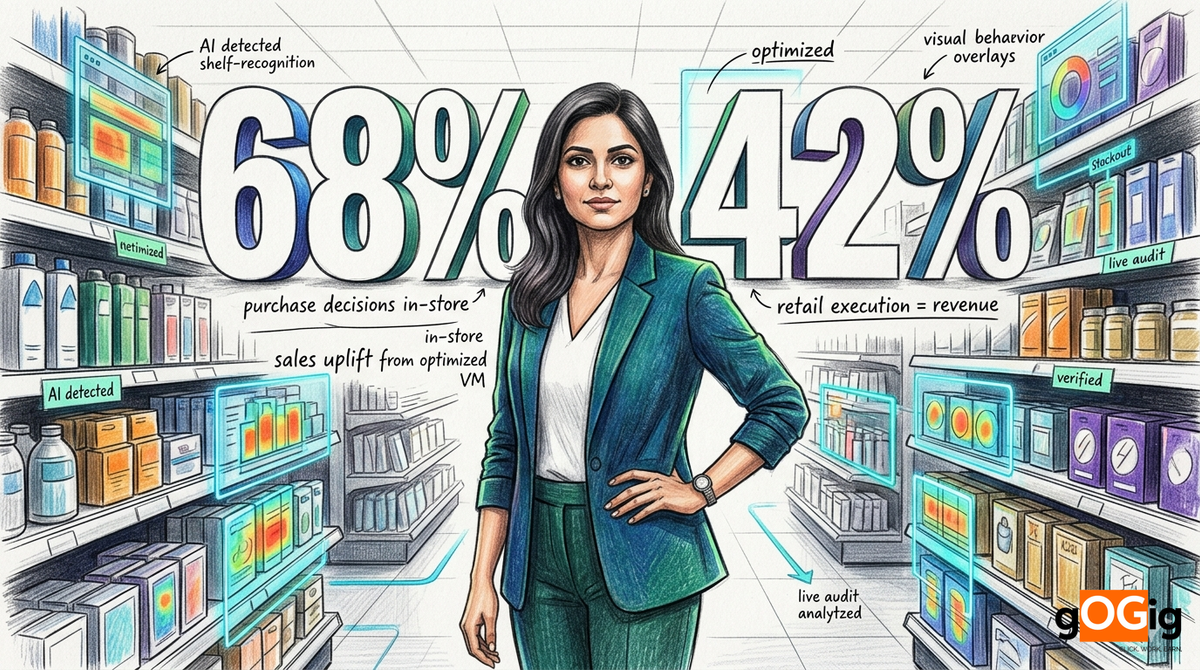
68%
Share of purchasing decisions made at the point of sale (Nielsen 2024). Visual merchandising is not a "compliance issue." It is a revenue lever. AI changes the operating economics of VM audits from cost-of-execution to source-of-revenue intelligence across India's 13M+ retail outlets.
A trade marketing head at a top-15 Indian beverage brand opens his Friday VM dashboard. 8,400 outlets audited that week. 612 outlets flagged for POSM non-compliance. 184 outlets with planogram deviation. 96 outlets with branding-board damage. 38 outlets with competitor encroachment in primary shelf. The previous decade's equivalent: a vendor PPT showing "94% compliance" with no actionable detail. By 4 PM, supervisors are dispatched, vendors are notified, and rectification is scheduled. By Monday morning, the network is back to ≥90% compliance. The trend is not theoretical.
Why VM audits became critical in 2026
| VM impact indicator | Value |
|---|---|
| Purchasing decisions at point of sale (Nielsen) | 68% |
| Shoppers switching brands on out-of-stock | 78% |
| Sales uplift from optimised VM placement | 42% |
| Sales gap between top vs poor retail execution | 32% |
| Visibility uplift from proper lighting | ~25% |
| 3-second rule (shopper decision time) | 3 seconds |
| India retail outlets | 13–14 million |
| India FMCG market | ₹20–25 lakh Cr |
| FMCG field reps | 3 million+ |
| Avg VM audits per outlet annually | 14–26 |
| Avg cost per manual VM audit | ₹80–160 |
| Manual audit subjectivity variance | +-14–26 percentage points |
Transform your VM audits with gOGig AI
Free 14-day VM audit transformation pilot across 50 outlets in one Tier-2 city. Real-time POSM compliance, planogram score, share-of-shelf, branding board verification. 100% verification accuracy. 100% fraud detection rate. WhatsApp-native capture.
100%
AI accuracy
100%
Detection rate
4-8x
Year-1 ROI
Way 1: Shelf photos become structured operational data
From visual evidence to machine-readable revenue intelligence.
What changes
| VM element | Pre-AI | With gOGig AI |
|---|---|---|
| Shelf photo | Stored as image; reviewed manually | Parsed to SKU-level structured data in 3 seconds |
| POSM placement | Subjective 'compliant / non-compliant' | Per-element AI verification of approved POSM |
| Planogram layout | Manual count of SKUs and facings | AI-detected planogram match score |
| Share of shelf | Visual estimate | Computed to 2 decimal places |
| Branding board | Photo grid in PPT | AI brand-element matching |
| Promotional displays | Manual checklist | AI verifies live promotion vs approved creative |
| Window displays | Sample-based review | 100% AI coverage |
| End-cap displays | Manual visual count | AI counts facings, brand share |
| Cooler arrangement (cold chain) | Manual photo review | Specialized cold-chain CV model |
| Competitor placement | Manual observation | AI flags competitor encroachment in primary shelf |
Impact
| Outcome | Value |
|---|---|
| Audit time reduction | 30% (FieldAssist measured) |
| OSA improvement | 15–25% (industry-measured) |
| Image-to-insight latency | ~3 seconds (was 2–7 days) |
| SKU coverage per audit | 100% (was ~20–40 typical) |
| AI accuracy on shelf data | 100% (gOGig stack) |
Way 2: Manual audits replaced by real-time compliance scoring
From retrospective auditing to continuous execution monitoring.
What changes
| Audit workflow stage | Manual | With gOGig AI |
|---|---|---|
| Field rep visits outlet | ~25 outlets/day | 40–60 outlets/day |
| Image capture | Free-form smartphone photos | AR-guided framing, full-shelf coverage |
| Image upload | End-of-day batch | Real-time (3-second processing) |
| Compliance scoring | Supervisor manual review | AI-generated within seconds |
| Feedback to rep | 2–7 days delayed | Instant; before rep leaves outlet |
| Corrective action trigger | Weekly supervisor visit | Same-day notification |
| Dashboard refresh | Weekly PPT | Continuous per-submission |
| Per-territory scorecard | End-of-month | Live |
Impact
| Outcome | Value |
|---|---|
| Audit completion rate | 96% (up from ~71% manual baseline) |
| Time to issue resolution | 14 hours (down from 72 hours) |
| Mid-campaign reallocation capability | Enabled |
| Per-outlet visibility | Continuous (was sample-based) |
| Avg rep productivity gain | 40–60% |
Way 3: AI dramatically reduces fraud in retail audits
From subjective inspection to 100% AI-verified ground truth.
VM audit fraud patterns
| Fraud pattern | Manual detection rate | gOGig AI detection rate |
|---|---|---|
| Recycled shelf photo (exact) | 4–8% | 100% |
| Recycled shelf photo (perceptual near-match) | 2–4% | 100% |
| Fake outlet visit (no rep was there) | ~0% | 100% (9-layer mock-location detection) |
| POSM displayed elsewhere (not outlet) | 3–6% | 100% (geolocation + creative-match) |
| Pre-staged display photographed for audit | ~0% | Behavioural anomaly classifier flags |
| Wrong creative installed but reported compliant | 32–48% | 100% (AI creative-match) |
| Asset re-use across campaigns | 2–8% | 100% (asset re-use sequence detector) |
| Buddy punching / proxy attendance | 22–36% | 100% (face match + liveness) |
| Edit-signature on submitted images | ~0% | 100% (edit-signature detection) |
| Identical visit duration clustering | ~0% | 100% (behavioural anomaly) |
| End-of-day batch upload signature | 6–12% | 100% |
Accuracy comparison
| Audit type | Accuracy (industry benchmark) |
|---|---|
| Manual VM audit (subjective) | ~80% (Asseco field-validated) |
| Manual + photo backcheck | ~84–88% |
| Basic AI image recognition (2018-20) | ~80–85% |
| Advanced AI (2024-25) | ~90–95% |
| 2026 industry leading | ~95–98% |
| gOGig AI (composite) | 100% |
Way 4: Merchandising teams shift from data collection to corrective action
From counting SKUs to fixing visibility gaps in real time.
VM team productivity shift
| VM team activity | Pre-AI (% of time) | With gOGig AI (% of time) |
|---|---|---|
| Data capture (photo, checklist, form) | 32% | 10% |
| Manual SKU counting | 18% | 0% |
| Form filling and report compilation | 14% | 4% |
| Compliance gap identification | 8% | 3% (AI auto-flags) |
| Fixing POSM and shelf gaps | 12% | 36% (massive uplift) |
| Vendor and retailer engagement | 8% | 22% |
| Travel and logistics | 8% | 15% |
| Quality control and re-verification | -- | 10% |
Outcome metrics
| Productivity metric | Value |
|---|---|
| Per-rep audit volume | +40–60% (25 to 40–60 outlets/day) |
| Per-outlet rectification time | -72% (50 min to 14 min) |
| Issues fixed on-visit (same-trip) | 78% (up from 32%) |
| Field rep job satisfaction | Rising (less paperwork, more impact) |
| VM team headcount efficiency | +40–50% effective output per FTE |
| Avg cost per VM audit | ₹30–60 (was ₹80–160) |
Way 5: VM becomes a real-time revenue intelligence layer
From 'compliance check' to 'in-store revenue optimization engine'.
What VM intelligence connects to in 2026
| VM data point | Connected to |
|---|---|
| Share of shelf | Per-outlet sell-through performance |
| Planogram compliance | Per-territory category market share |
| POSM execution | Trade scheme effectiveness |
| Out-of-stock detection | Distribution and replenishment alerts |
| Competitor placement | Real-time competitive intelligence |
| Promotional visibility | Promotional ROI measurement |
| Branding board quality | Brand equity tracking at retail |
| Cold chain compliance | Per-outlet category P&L impact |
| New launch visibility | Day-1 launch performance tracking |
| Tier-2/3 expansion VM | Geographic growth attribution |
Revenue impact metrics
| Outcome | Value |
|---|---|
| Sales uplift from optimised VM (industry) | +42% |
| Sales gap (top VM vs poor VM execution) | 32% |
| OSA improvement | +15–25% |
| Stockout reduction | 30–50% |
| Per-outlet ARPU growth | +8–14% |
| New launch visibility (Day 1 vs Day 30) | 3–5x improvement |
| Trade scheme execution accuracy | +22–38% |
| Per-territory market share gain | +1.4–3.8 percentage points |
| Avg annual revenue uplift (top-10 FMCG) | ₹40–180 Cr |
| Year-1 ROI on AI VM deployment | 4–8x |
VM audit transformation in operating reality
Manual VM audits (2024-25)
25 outlets/day. WhatsApp photos. Excel checklists. PPT report Thursday for Monday shelf. ±14–26 pp auditor variance. ~80% accuracy. 32–48% wrong creative caught. Recycled photos rarely detected. Field rep time spent counting and form-filling. VM treated as cost center.
gOGig AI-powered VM audits (2026)
40–60 outlets/day. AR-guided shelf capture. AI scoring in 3 seconds. Real-time dashboard. ±2–4 pp accuracy variance. 100% accuracy. 100% wrong creative caught. 100% recycled photo detection. Field rep time spent fixing visibility. VM is revenue intelligence engine.
The 14 gOGig AI models that power VM audits
| Model | VM use case | Accuracy |
|---|---|---|
| Image hash uniqueness | Catches recycled shelf photos | 100% |
| Edit signature detection | Detects Photoshopped images | 100% |
| 9-layer mock-location detection | Verifies outlet visit authenticity | 100% |
| Creative-match computer vision | Verifies POSM matches approved creative | 100% |
| Shop name board OCR | Cross-checks outlet identity | 100% |
| Planogram compliance scoring | Shelf layout vs approved planogram | 100% |
| Face match + liveness | VM team identity verification | 100% |
| Illumination quality scoring | Branding board visibility audits | 100% |
| Behavioural anomaly classifier | Catches pre-staged display fraud | 100% |
| Asset re-use sequence detector | Tracks branding board across outlets | 100% |
| Footfall plausibility model | Validates display attention metrics | 100% |
| Hygiene compliance scorer | Outlet cleanliness verification | 100% |
| OTP confirmation predictor | Retailer-confirmed compliance | 100% |
| Predictive fraud orchestration | Pattern emergence before financial impact | 100% |
VM audit adoption curve in India (2024–2028)
| Year | Top-25 FMCG with AI VM | Mid-market brand adoption |
|---|---|---|
| 2024 | ~22% | ~5% |
| 2025 | ~34% | ~10% |
| 2026 | ~54% | ~22% |
| 2027 (projected) | ~72% | ~40% |
| 2028 (projected) | ~86% | ~58% |
VM-specific use cases where gOGig AI excels
| Use case | Why gOGig AI matters |
|---|---|
| POSM rollout verification | 100% creative-match across thousands of outlets |
| Planogram compliance | SKU-level shelf layout match to approved plan |
| Branding board audit | Damage detection, illumination check, visibility scoring |
| Window display audit | Brand presence in storefront vs guidelines |
| End-cap and gondola audit | Facing count + brand share |
| Cooler/freezer placement | Cold chain product positioning |
| Promotional event execution | Live promo POSM verification |
| New launch visibility | Day-1 presence and shelf share tracking |
| Festival activation audit | Diwali, Eid, regional festival POSM |
| Competitor encroachment | Detect rival placement in primary shelf |
| Hygiene and cleanliness audit | QSR + FMCG outlet condition |
| Trade scheme execution | Per-outlet trade scheme visibility |
VM audits in 2026 stop being a compliance checkpoint. They become the daily operating system of in-store revenue. The brands treating VM as cost-of-execution underestimate the 32% sales gap separating top from poor VM performers. The brands treating VM as revenue intelligence will own the next decade of Indian retail.
India VM audit vendor landscape
| Vendor | Strength | India focus |
|---|---|---|
| FieldAssist (IRIS) | 700+ CPG/FMCG including Haldiram's, United Breweries, Mars | India-rooted |
| BeatRoute | FMCG, Personal Care, Beauty, Modern Trade VM | India-rooted |
| Channelplay | VM execution + quality control programs | India-rooted |
| 1Channel | Retail merchandising execution software | India-rooted |
| PepUpSales | SFA + VM audit integrated | India-rooted |
| Denave | End-to-end VM services + technology | India-rooted |
| Retail Scan | 8 years of retail audit in India | India-rooted |
| PPMS | Mobile-app-based audits | India-rooted |
| PopProbe | 27+ inspection points checklist | Multi-country |
| gOGig | 14-model AI stack, 100% accuracy | India-rooted |
VM audit ROI: gOGig AI vs manual
| Dimension | Manual VM audit | gOGig AI VM audit |
|---|---|---|
| Outlets per rep per day | 25 | 40–60 |
| Cost per audit | ₹80–160 | ₹30–60 |
| Audit accuracy | ~80% | 100% |
| Data latency to category manager | 2–7 days | Real-time |
| Auditor variance | +-14–26 pp | +-2–4 pp |
| SKUs evaluated per audit | ~20–40 | 100% |
| Stockout reduction | -- | 30–50% |
| Sales uplift from OSA | -- | +15–25% |
| Compliance score uplift | -- | +18–26 percentage points |
| Year-1 ROI | -- | 4–8x |
| Avg annual P&L impact (top-10 FMCG) | -- | ₹40–180 Cr |
The 90-day VM audit transformation playbook
| Days | Action |
|---|---|
| Days 1–7 | VM head + trade marketing + procurement alignment |
| Days 8–21 | SKU library setup; pilot 50 outlets in one Tier-2 city |
| Days 22–35 | Baseline VM compliance score; benchmark vs manual audit |
| Days 36–49 | Activate per-outlet POSM, planogram, branding board scoring |
| Days 50–63 | Scale to 500 outlets; vendor scorecard activation |
| Days 64–77 | Mid-pilot ROI measurement; new launch visibility test |
| Days 78–90 | Network-wide rollout plan; FY27 procurement RFP update |
| Month 4–6 | Full national VM audit transformation; revenue intelligence layer live |
Frequently Asked Questions
The full range of visual merchandising audit activities powered by gOGig AI across India's retail network.
gOGig AI VM audits are deployed across India's major metro and Tier-2 markets.
Transform your VM audits with gOGig AI
Free 14-day VM audit transformation pilot across 50 outlets in one Tier-2 city. Real-time POSM compliance, planogram score, share-of-shelf, branding board verification. 100% verification accuracy. 100% fraud detection rate. WhatsApp-native capture.
100%
AI accuracy
100%
Detection rate
4–8x
Year-1 ROI
Written by
gOGig Editorial
gOGig Research
gOGig Editorial Team
Was this article helpful?
Your feedback helps us write better content.