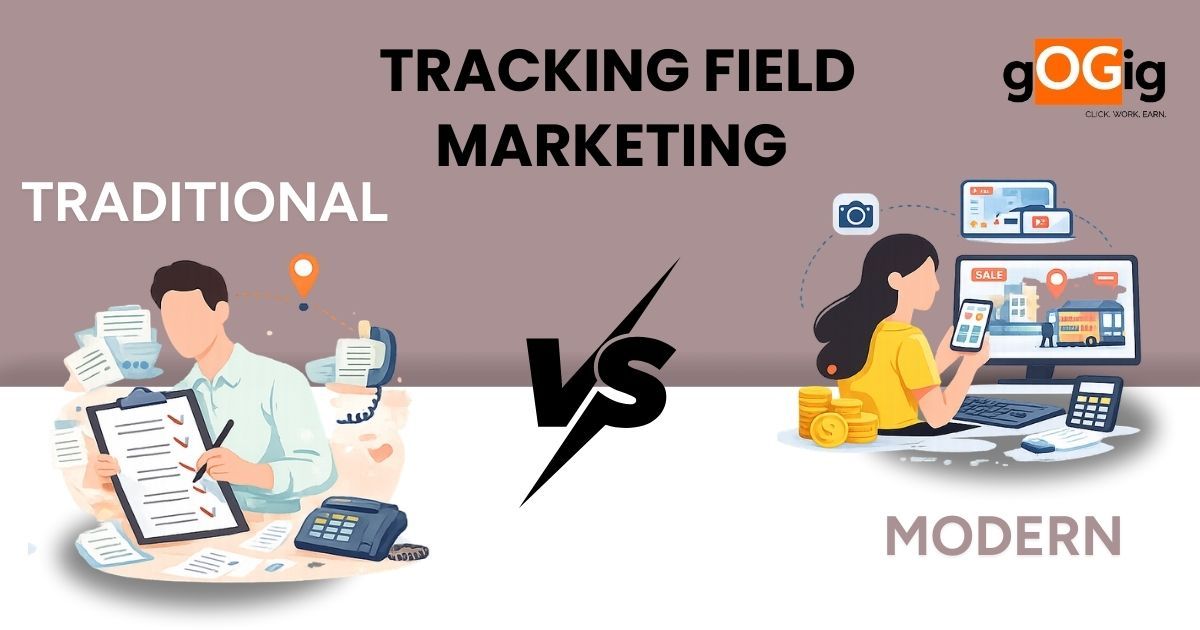
A brand launches a field marketing campaign across multiple cities, involving retail branding, transit advertising, and on-ground activations. While these campaigns create strong visibility, marketing teams often face a critical challenge: how to track field marketing campaigns effectively across multiple locations and teams.
In large-scale campaigns, relying on manual updates is no longer sufficient. Brands increasingly adopt field marketing tracking tools, field marketing monitoring software, and systems designed for real-time field marketing tracking to ensure accurate execution and visibility. These solutions help teams track offline marketing campaigns, verify installations, and monitor campaign progress without delays. Understanding how gOGig solves this for brands at scale is what separates campaigns that get managed from campaigns that get assumed.
As campaigns grow in scale and complexity, using a structured field campaign tracking system becomes essential. Modern tracking methods allow marketing teams to maintain real-time visibility, reduce execution gaps, and manage campaign activities more efficiently compared to traditional approaches.
What Is Field Marketing Execution Tracking And Why Does It Matter
Field marketing covers everything that happens at a physical location - retail promotions, transit branding, product sampling, kiosk activations, and event marketing. Unlike digital campaigns where every click and impression is automatically logged, field marketing happens in the real world. Nobody automatically records whether a retail display was installed correctly, whether a field agent visited the right outlet, or whether a branding material was placed where it was supposed to be.
Tracking field marketing execution means building a system to answer those questions, not after the campaign ends, but while it is still running. This is precisely the gap that platforms like gOGig are built to close, giving marketing teams live answers to questions that traditional reporting methods can only answer days later.
This matters for a simple reason: by the time a campaign ends and you review the final report, there is nothing left to fix. Non-compliance identified in week one can be corrected. The same issue identified in week six has already cost the brand four weeks of missed visibility and wasted spend.
Why Manual Field Marketing Monitoring Fails at Scale
For smaller campaigns running across a handful of locations, manual tracking is manageable. Field agents call in updates. A manager maintains a spreadsheet. Photos come through WhatsApp. It works - barely, but it works.
The moment a campaign expands across multiple cities, multiple vendors, and hundreds of locations, every weakness in the manual approach becomes a serious operational problem. This is the exact scenario where brands using gOGig consistently report the biggest shift moving from fragmented, delayed updates to a single live view of execution across every city and vendor simultaneously.
Updates arrive through too many channels. Phone calls, WhatsApp messages, emails, and spreadsheet entries all feed different parts of the picture. No single person has a complete view of campaign status at any point in time. By the time information is compiled into something usable, it is already outdated.
Reporting is always delayed. Field teams submit updates after completing tasks, sometimes hours later, sometimes the next day. For a brand trying to make real-time decisions about where to deploy correction teams or how to respond to gaps, this delay is critical. The campaign keeps running on the ground while the brand team is still reviewing yesterday's reports.
Photo proof is impossible to verify. A photo shared via WhatsApp tells you almost nothing without a GPS coordinate and a timestamp. Was it taken at the right location? When? By someone who was actually there? Without tamper-proof verification, the kind gOGig applies automatically to every submission photo submissions are claims, not proof.
Accountability dissolves across vendors. Multi-city campaigns typically involve multiple execution partners. When something goes wrong, responsibility gets passed around. Without location-level data tied to specific vendors, the brand team has no way to identify where the failure actually happened or hold the right partner accountable.
How gOGig Simplifies Field Marketing Campaign Tracking
gOGig is built for brands running field marketing campaigns across multiple cities and vendor networks. It converts what is currently an unmanageable flow of WhatsApp messages, spreadsheets, and delayed reports into a structured, verified, real-time monitoring system, without asking field teams to change how they work.
No app download required - submissions happen through WhatsApp. The biggest reason field marketing tracking systems fail is that field agents don't adopt them. gOGig removes this barrier entirely. Field agents submit geotagged execution photos through a single WhatsApp number. The verification, compliance checking, and dashboard update all happen automatically on the backend. Field teams do what they already do. The brand team gets verified, structured data.
Every submission is tamper-proof and verified. GPS coordinates confirm location. Timestamps confirm timing. Live camera capture confirmation prevents gallery photo submissions. Each piece of proof your brand receives through gOGig is genuinely tied to a specific location and moment, not a claim that happens to come with a photo attached.
Multi-city, multi-vendor campaign visibility in one dashboard. Whether your field marketing campaign spans three cities or thirty, gOGig aggregates all execution data into a single live view. Campaign managers see overall progress, compliance rates by city, vendor performance breakdowns, and pending locations, without chasing updates from individual partners.
Structured reports replace manual compilation. At any point during or after the campaign, gOGig generates compliance reports showing submission history, location-level status, vendor performance, and flagged issues. Reports that used to take a week to compile are available instantly in formats ready for internal review or client presentation.
Frequently Asked Questions About Field Marketing Campaign Tracking
How do you track field marketing campaigns across multiple cities? Through a centralized system that collects geotagged, timestamped photo proof from every location and aggregates it into a live dashboard, broken down by city, vendor, and location. Platforms like gOGig work well for multi-city campaigns because submissions happen through WhatsApp, making field team adoption high without any training or app installation.
What is the best tool for tracking field marketing execution? The best tool is one your field teams will actually use. gOGig consistently works well across large distributed field teams because it operates through WhatsApp,which agents already use daily, while automatically handling GPS verification, compliance checking, and real-time dashboard updates on the backend. Beyond adoption, look for GPS-verified photo submissions, real-time compliance dashboards, automated alerts, and vendor-level performance breakdowns.
Why is real-time field marketing monitoring important? Because problems identified during a campaign can be corrected. Problems identified after it cannot. gOGig's real-time dashboard and automated alerts mean a missed installation flagged on Tuesday can be rectified by Thursday. The same issue identified in the post-campaign report has already cost the brand weeks of missed visibility.
How do you verify field marketing execution proof authentically? By requiring submissions to be GPS-verified, timestamped, and captured via live camera not uploaded from a gallery. gOGig's tamper-proof photo submission system ensures each proof is genuinely tied to a specific location and moment, removing the possibility of fabricated or recycled submissions that self-reported systems cannot catch.
How do you hold field marketing vendors accountable for execution gaps? With location-level compliance data tied to specific time periods. gOGig's vendor-level compliance dashboard shows exactly which locations a specific vendor missed, for how many days, verified through GPS-confirmed photo proof. A compliance conversation backed by this data is not disputable. Vendor accountability only works when it is based on verified evidence, not impressions.
Can field marketing campaigns in Tier 2 and Tier 3 cities be tracked effectively? Yes and this is one of the areas where gOGig works particularly well. Because submissions happen through WhatsApp rather than a dedicated app, field agents in Tier 2 and Tier 3 markets can submit verified proof without any technical onboarding. GPS verification and automated compliance checking work consistently regardless of geography or market size.
The Real Cost of Untracked Field Marketing Campaigns
A field marketing campaign running at 60% actual execution compliance costs the same as one running at 92%. The brand team paid for presence at every location. What it got was partial presence, delayed reporting, and a final report that reflects vendor claims rather than verified on-ground reality.
At a small campaign scale, this is a frustrating but manageable problem. At the scale of a multi-city campaign involving hundreds of locations and multiple execution partners, it is a significant and recurring budget leak.
The shift from manual field marketing monitoring to structured, real-time execution tracking is not a technology upgrade. It is a fundamental change in how campaign accountability works moving from trust-based reporting to verified, data-driven evidence.
gOGig gives marketing teams the infrastructure to make that shift without disrupting existing field team workflows. GPS-verified submissions, live dashboards, automated alerts, vendor-level compliance tracking, and instant reporting, all built around the WhatsApp workflow your field teams already use. For any brand running field marketing at scale, it is the difference between hoping the campaign ran correctly and actually knowing it did.