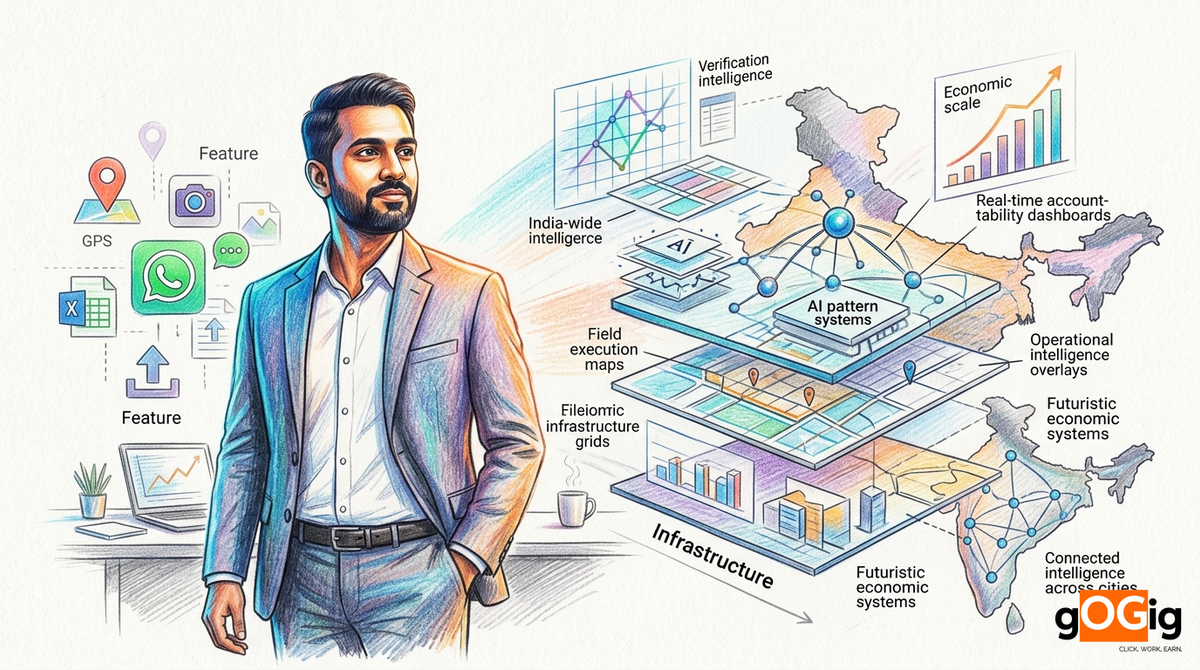
Why "GPS + photo + WhatsApp" is the wrong way to position gOGig
A category-level analysis of why feature-led messaging undervalues Field Execution Intelligence, what the larger positioning actually is, and what the industry vocabulary shift looks like over the next three years.
5 layers deep
The positioning ladder for verification platforms in India's physical economy. Tier 1 is feature. Tier 5 is infrastructure. Most companies position one or two tiers too low. The cost of that error compounds.
A B2B SaaS founder explains their product as "GPS + Photo + WhatsApp." Three nouns. Three features. A spec sheet. The category that line creates has a ceiling. The category that lives one layer up has a different ceiling. The category two layers up has no ceiling India has discovered yet. This is why positioning is not a marketing exercise. It is the most consequential business decision a category-creating company makes.
The positioning ladder, 5 tiers
Feature-led: "GPS + Photo + WhatsApp"
Three nouns. Three capabilities. Reads as a spec sheet. Ceiling: ₹500 Cr category. Competes against hundreds of similar offerings. Commoditised within 24 months.
Capability-led: "Field force tracking software"
One verb, one noun. Easier to understand. Still framed around what the software does, not what changes for the buyer. Ceiling: ₹2,000 Cr category. Competes against established players.
Outcome-led: "BTL execution verification"
Verified outcome named. The buyer understands what they get. Ceiling: ₹8,000 Cr category. Competes only with audit firms and emerging FEI platforms.
Category-led: "Field Execution Intelligence"
New named category. Buyer mental model changes. The conversation moves from "which vendor" to "which standard." Ceiling: ₹25,000 Cr category. Competes with the absence of category itself.
Infrastructure-led: "Proof-of-work layer for physical economy"
The category becomes a primitive, not a product. Comparable to how Google Analytics became the proof layer for digital. Ceiling: ₹100,000+ Cr category. Competes with the historical norm of unverified execution.
Why Tier 1 fails commercially
Feature-led positioning is not wrong because it's inaccurate. It's wrong because it leaves the largest commercial opportunity uncreated.
| Tier 1 failure mode | Commercial consequence |
|---|---|
| Reads as spec sheet, not strategy | Buyers default to price comparison |
| Vendor commoditisation pressure | Margins compress as competitors copy features |
| CFO never enters the conversation | Deal size capped at marketing budget allocation |
| BRSR Core / audit positioning lost | Procurement and audit conversations never start |
| Comparison to existing tools | "How is this different from TrackoField?" |
| Sales cycle elongates | Each feature must be defended individually |
| Buyer mental model: "another tracker" | Brand never escapes the tracker category |
| Talent acquisition signals weaken | Engineering candidates compare to attendance apps |
Feature vs outcome: the same capability, two different sales conversations
Feature-led version: "We use GPS, photo, and WhatsApp to track field campaigns."
Outcome-led version: "We verify your BTL execution in 3 seconds and surface ₹15–28 lakh of invisible loss for every ₹1 crore spent."
What changes between the two versions
| Dimension | Feature-led | Outcome-led |
|---|---|---|
| Buyer's mental model | "This is a tracking app" | "This is a verification standard" |
| Stakeholder pulled into the deal | Marketing operations | CMO + CFO + procurement + audit |
| Conversation starts with | Feature comparison | Financial exposure |
| Reference for ROI math | "Saves promoter time" | "Protects ₹18–28 lakh per ₹1 Cr" |
| Budget line item | Marketing operations tool | Risk management infrastructure |
| Procurement framing | Vendor selection | Category standard adoption |
| Annual contract value range | ₹3–15 lakh | ₹40 lakh–3 Cr |
| Sales cycle length | 3–6 months | 2–4 months (CFO closes faster) |
The vocabulary problem in detail
| Vocabulary used (feature-led) | Vocabulary avoided |
|---|---|
| Tracking | Verification |
| Reporting | Accountability |
| Field force management | Field execution intelligence |
| GPS / photo / WhatsApp | Ground truth |
| Audit tool | Trust infrastructure |
| Compliance monitoring | Proof before payment |
| Software for promoters | Operating layer for physical economy |
| Activity logging | Verified execution rate |
| Field tracker | Proof-of-work layer |
| Geo-fence and timestamps | Independent verification |
The phrases that should disappear from category communication
Phrase 1: "We are like a GPS tracker for promoters."
Phrase 2: "WhatsApp + photo + GPS is our core capability."
Phrase 3: "We help brands track their BTL campaigns."
Phrase 4: "Our platform offers GPS-based check-in and photo proof of execution."
The phrases that should replace them
Phrase 1: "Field Execution Intelligence is the verification layer for India's ₹80,000 Cr physical economy."
Phrase 2: "Brands using FEI surface ₹15–28 lakh of invisible loss for every ₹1 Cr of BTL spend."
Phrase 3: "Offline work. Online proof. Every campaign, every city, every rupee verified."
Phrase 4: "Proof before payment. The procurement standard for BTL in 2026."
Why outcome-led positioning closes faster
| Buyer behaviour signal | Feature-led response | Outcome-led response |
|---|---|---|
| "Show me how this works" | 15-slide product walkthrough | 2-slide ROI math, ₹exposure framework |
| "What's different from competition?" | Feature comparison matrix | Category framing, FEI vs old way |
| "What does our CFO need to know?" | "They don't, this is marketing tech" | ₹exposure quantification + BRSR alignment |
| "Why now?" | "BTL is growing fast" | BRSR Core FY26 + procurement governance shift |
| "What's the timeline to ROI?" | "Save reporting time" | 4–8x ROI on first campaign verified |
| "How do we measure success?" | Activity reports, dashboards | Verified execution rate, board KPI |
| "What contract clauses change?" | "Standard SOW" | Proof Before Payment MSA template |
Read the Big Idea library
11 founding pieces of FEI category vocabulary. The full library of category-defining content that moves the conversation from feature to infrastructure.
Explore the Big Idea library →Lessons from comparable B2B category creators
| Company | Tier 1 feature | Tier 5 infrastructure |
|---|---|---|
| Gong | "Records sales calls" | "Revenue intelligence platform" |
| Slack | "Group messaging app" | "Operating system for teams" |
| SafetyCulture | "Inspection checklist app" | "Operations platform for frontline teams" |
| Outreach | "Email sequencer" | "Sales execution platform" |
| Datadog | "Server monitoring" | "Observability platform for cloud applications" |
| Snowflake | "Cloud data warehouse" | "Data cloud" |
| Stripe | "Online payment API" | "Financial infrastructure for the internet" |
| HubSpot | "Email marketing tool" | "Customer platform" |
Outcomes of comparable category creation moves
| Company | Tier 1 valuation | Tier 5 valuation | Multiplier |
|---|---|---|---|
| Gong | ~$500M (early product) | $7.25B (2021) | ~14x |
| Slack | ~$1.1B (Series E pre-rebrand) | $27.7B (Salesforce acquisition) | ~25x |
| SafetyCulture | ~$300M (early) | $2.7B (2022) | ~9x |
| Outreach | ~$400M (Series D) | $4.4B (Series G) | ~11x |
| Datadog | ~$650M (pre-IPO) | $40B+ (current) | ~60x |
| Snowflake | ~$1.5B (Series E) | $70B+ (current) | ~47x |
| Stripe | ~$1.75B (Series B) | $70B (2024) | ~40x |
Every successful B2B category creator made the same move. They started with a feature, and over 3–5 years, climbed the positioning ladder until the category itself was named after their orientation. The valuation multiplier between Tier 1 and Tier 5 averages 9x to 60x.
The Field Execution Intelligence category, in 2026
| Category attribute | FEI category in 2026 |
|---|---|
| Named category status | Emerging, early-stage formalisation |
| Total addressable market (India) | ₹80,000 Cr physical economy spend |
| Serviceable addressable market | ₹15,000–22,000 Cr accountability layer |
| Comparable adjacent global categories | Retail Execution Software ($304M), Field Service Management ($5.49B), Field Sales Software ($2.8B), EHS/Audit ($3.1B) |
| Buyer roles activated | CMO, CFO, procurement, internal audit, ESG, board |
| Procurement category | Risk management / governance, not marketing operations |
| Regulatory tailwind | BRSR Core mandatory FY 2025-26 (top 250 listed) |
| Comparable global predecessor | Google Analytics for digital (Nov 2005) |
The 5 questions that define the larger category
| Question | What it surfaces |
|---|---|
| What actually happened? | Ground truth verification |
| Was it compliant? | Contract enforcement, audit standard |
| Was it effective? | Outcome measurement |
| Was it worth paying for? | Procurement justification |
| What changed because of the execution? | Performance attribution |
A platform that answers only "where was the device" is positioned to compete with ₹500 Cr categories. A platform that answers all five questions is positioned to compete for the ₹15,000–22,000 Cr accountability layer of India's physical economy.
8 strategic risks of mispositioning
Talent acquisition cap
Top engineering and product talent compares mission scope. "Tracker for promoters" doesn't compete with "infrastructure for India's physical economy" for ambitious hires.
Investor multiple compression
Tier 1 features get vertical SaaS multiples (5–8x revenue). Tier 5 infrastructure plays get platform multiples (15–30x revenue). 3x valuation difference compounds across funding rounds.
Competitor feature parity
GPS, photo, WhatsApp can be replicated by any competitor within 12–18 months. Category vocabulary, on the other hand, cannot be replicated.
CFO conversation impossibility
A "GPS tracker" never reaches the CFO's desk. A "₹80,000 Cr accountability layer" enters the CFO conversation by default. Stakeholder access determines deal size.
Press positioning weakness
Journalists writing about Indian marketing accountability in 2026-27 will cite the company with the cleanest category vocabulary. Feature-led players don't appear in the citations.
BRSR Core positioning gap
SEBI's value chain disclosure requirements require infrastructure-level positioning to be substantiable. Feature-led platforms cannot satisfy assurance providers.
Analyst coverage exclusion
Gartner, Forrester, IDC, and IDC Spectrum cover categories, not features. Without category positioning, analyst-driven enterprise sales never starts.
Acquisition story limitation
Tier 1 features get tuck-in acquisition prices. Tier 5 infrastructure plays get strategic acquisition premiums. The exit math is determined years before the exit event.
What the larger category narrative looks like
The two narratives, side by side
Tier 1 narrative
"We help brands manage their field execution using GPS, photos, and WhatsApp. Our platform tracks promoter attendance, sends location data, and helps brand managers monitor campaigns." The reader's mental category: another tracking app.
Tier 5 narrative
"India's ₹80,000 Cr physical economy operates without an accountability layer. Digital marketing got Google Analytics. Field execution got WhatsApp. Field Execution Intelligence is the verification infrastructure for the world's largest unverified marketing channel." The reader's mental category: foundational infrastructure.
The category vocabulary, in order of strength
| Vocabulary tier | Sample phrases |
|---|---|
| Strongest (infrastructure) | "Proof-of-work layer for the physical economy", "Accountability layer for ₹80,000 Cr", "Trust infrastructure for marketing supply chains" |
| Strong (category) | "Field Execution Intelligence", "Ground Truth verification", "Physical operations intelligence" |
| Medium (outcome) | "BTL execution verification", "Verified offline marketing", "Real-world proof platform" |
| Weak (capability) | "Field force tracker", "Promoter management software", "BTL audit tool" |
| Weakest (feature) | "GPS + Photo + WhatsApp", "Geo-tagged check-in", "AI-based photo verification" |
The B2B positioning pyramid for FEI
| Pyramid layer | FEI positioning | Conversation target |
|---|---|---|
| Apex (vision) | "Bringing accountability to ₹80,000 Cr" | Board, investors, press |
| Strategic (category) | "Field Execution Intelligence is the new operating standard" | CMO, CFO, audit committee |
| Outcome (financial) | "₹15–28 lakh protected per ₹1 Cr BTL spend" | CFO, procurement, finance |
| Capability (operational) | "3-second verification, 9 AI models, real-time dashboards" | Marketing operations, brand managers |
| Feature (technical) | "GPS, photo, WhatsApp, EXIF, geo-fence" | IT, technical buyers, integration team |
Why the pyramid order matters
| If conversation starts at | What gets discussed | Deal size outcome |
|---|---|---|
| Apex (vision) | Board, vision, category | ₹1–5 Cr deals |
| Strategic (category) | Operating standard adoption | ₹50 lakh–2 Cr deals |
| Outcome (financial) | ROI math, exposure protection | ₹25 lakh–1 Cr deals |
| Capability (operational) | Workflow improvements | ₹5–25 lakh deals |
| Feature (technical) | Tool comparison | ₹2–10 lakh deals |
The same product can be positioned at any of the five layers. The choice of starting layer determines the buyer in the room, the budget line item, and the deal size that follows.
The trajectory: how the category vocabulary will evolve
| Period | Dominant vocabulary | Buyer mental model |
|---|---|---|
| Pre-2024 | "BTL reporting tools", "Field force tracker" | Internal tool for ops teams |
| 2024–2025 | "BTL execution verification", "GPS + photo platforms" | Audit alternative for marketing |
| 2026–2027 | "Field Execution Intelligence (FEI)", "Ground Truth platforms" | Procurement-grade verification layer |
| 2028–2029 | "Proof-of-work layer for physical economy" | Foundational infrastructure for accountability |
| 2030+ | "Operating standard for offline marketing" | Default category that doesn't need explanation |
What infrastructure-led positioning enables
| Unlocked capability | What it produces |
|---|---|
| CFO enters every deal | 3–5x larger annual contract values |
| BRSR Core alignment becomes default | Listed company adoption accelerates |
| Press cites category, not feature | Industry vocabulary forms around the company |
| Analyst firms cover the category | Gartner / Forrester / IDC coverage by 2027-28 |
| International expansion becomes coherent | Category travels; features need re-explaining |
| Acquirers value the category, not the product | Strategic premium on exit |
| Talent acquisition narrative strengthens | Top engineering and PM hires accept lower salary for category significance |
| Investor narrative becomes platform-tier | Series B+ multiples reflect platform potential |
Industry signal: what other category creators in India are doing
| Indian B2B category creator | Tier 1 framing avoided | Tier 5 framing adopted |
|---|---|---|
| Razorpay | "Payment gateway" | "Financial infrastructure" |
| Zoho | "CRM software" | "Operating system for business" |
| Freshworks | "Helpdesk software" | "Customer experience suite" |
| BrowserStack | "Browser testing tool" | "Software testing infrastructure" |
| Postman | "API testing app" | "API platform" |
| Chargebee | "Subscription billing" | "Revenue growth management platform" |
| Darwinbox | "HR software" | "Workforce experience platform" |
The pattern across these category creators
| Common pattern | Observation |
|---|---|
| Vocabulary shift in years 3–5 | Tier 1 in early stage; Tier 5 once revenue scale is reached |
| Multiplier reset at vocabulary shift | Each company saw 4–15x valuation multiple expand after positioning shift |
| International expansion follows | Tier 5 positioning travels across markets; Tier 1 requires re-localisation |
| Press positioning aligns to category | Coverage moves from "X product" to "Indian platform redefining Y" |
| Analyst coverage follows | Forrester / IDC / Gartner inclusion 12–24 months after vocabulary shift |
What this means for the FEI category in 2026
| Category development task | Owner | 2026 milestone |
|---|---|---|
| Vocabulary anchoring | Editorial / content | Field Execution Intelligence cited in 25+ press pieces |
| Analyst engagement | Founder / marketing | First Gartner / Forrester briefing taken |
| Customer narrative shift | Sales / marketing | 50% of new ACV from outcome-led pitches |
| BRSR Core alignment | Product / customer success | BRSR audit pack templates shipped |
| Procurement category positioning | Customer success | 10+ enterprise customers add PBP clauses to MSAs |
| Press relationship building | Marketing / founder | 5+ tier-1 publications with established beat reporter |
| Investor narrative refresh | Founder | Series B pitch built around Tier 5 framing |
| International market scoping | Strategy | SEA + MEA market sizing complete |
The risk of staying at Tier 1 too long
| Risk timing | What happens if Tier 1 persists |
|---|---|
| 0–6 months | Sales conversations stall at marketing operations level |
| 6–12 months | Competitors copy GPS+photo+WhatsApp; differentiation erodes |
| 12–18 months | CFO conversations remain inaccessible; deal size capped |
| 18–24 months | Press positioning solidifies around competitors with stronger category vocabulary |
| 24–36 months | Analyst firms cover competitors as category leaders; trail follows |
| 36+ months | Category vocabulary becomes immovable; positioning shift gets exponentially harder |
In B2B SaaS, the category vocabulary you anchor on in years 2–4 becomes the ceiling on what you can become in years 5–10. Tier 1 framing is not a marketing problem. It is a structural commercial bet.
The buyer journey at each positioning tier
| Stage | Tier 1 buyer journey | Tier 5 buyer journey |
|---|---|---|
| Discovery | Search "BTL tracking software" | Read industry report on accountability gaps |
| Awareness | "This looks like a useful tool" | "This is reshaping how we operate" |
| Consideration | Compare 6 similar tracking apps | Read about FEI category, identify gOGig as leader |
| Evaluation | Feature checklist comparison | Strategic fit + ROI math + procurement readiness |
| Decision committee | Marketing operations only | CMO, CFO, procurement, audit, ESG |
| Procurement framing | Marketing operations purchase | Risk management infrastructure purchase |
| Close cycle | 3–6 months | 2–4 months (CFO closes faster) |
| Annual contract value | ₹3–15 lakh | ₹40 lakh–3 Cr |
| Year 2 expansion | 1.2–1.5x | 2.5–4x (category becomes standard) |
The vocabulary discipline at scale
| Customer-facing surface | Discipline required |
|---|---|
| Homepage | Lead with category, not feature |
| Sales decks | Open with industry context, close with feature |
| Press releases | Frame as category milestone, not product feature |
| Investor pitches | Anchor on TAM/SAM/SOM of the larger category |
| Customer case studies | Outcomes in rupees, not features in checkboxes |
| Job descriptions | Mission-level framing for senior hires |
| RFP responses | Reframe procurement language toward the category |
| Analyst briefings | Position as category leader, not vendor |
| Conference talks | Industry vocabulary first, product second |
| LinkedIn content | Education on the category, not promotion of the product |
What changes when the vocabulary holds
| Vocabulary discipline outcome | Business impact |
|---|---|
| Industry press uses category terms | Brand becomes default mental anchor |
| Competitors get framed as "GPS tools" | Competitor positioning weakens |
| Analyst reports name the category | Enterprise procurement processes route to category leader |
| RFPs ask for FEI capability | Inbound deal flow improves |
| CFOs cite the category in board reviews | Adoption accelerates across portfolio companies |
| Procurement governance adopts PBP | Category becomes operating standard, not vendor preference |
| International press picks up the term | Global expansion gets a vocabulary head start |
| Engineering hires arrive citing the category | Talent quality compounds over 24 months |
Frequently Asked Questions
Read the Big Idea library
Eleven founding pieces of FEI category vocabulary. The full library of content that establishes the larger industry narrative. Built for editorial, analyst, and investor audiences.
5
Positioning tiers
₹500 Cr
Tier 1 ceiling
₹1 lakh Cr+
Tier 5 ceiling
Written by
gOGig Editorial
Strategy & Category Team
The gOGig Editorial team publishes original thinking on category creation, B2B positioning, and the vocabulary of Field Execution Intelligence for India's physical economy.
Was this article helpful?
Your feedback helps us write better content.