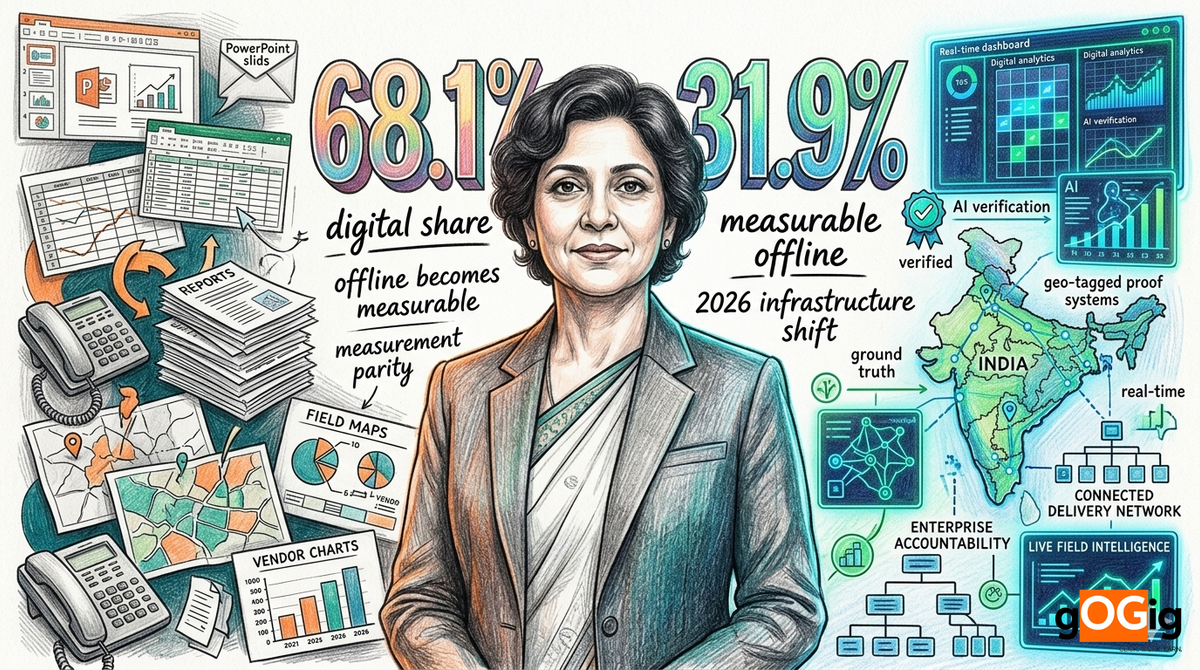
Why 2026 is the year offline marketing becomes measurable like digital
A foundational thesis from gOGig on the convergence of three infrastructure shifts making 2026 the inflection year for offline measurement. Built for CMOs, CFOs, procurement leaders, agency founders, and investors who need to understand the measurement-parity transition reshaping India's ₹80,000 Cr physical economy.
68.1%
Digital's share of India's 2026 ad market. Offline still commands the remaining 31.9% (~₹65,000 Cr), but it has been the unmeasurable layer for a decade. Three infrastructure shifts converging in 2026 close that gap structurally. The measurement asymmetry that defined Indian marketing for 15 years ends this year.
A CFO at a Nifty 100 brand walks into the FY26 marketing review. The digital section shows real-time ROAS, attribution paths, fraud detection metrics, cohort analysis, and ML-driven optimization. The offline section shows three slides: a PPT with photos, a vendor-completed Excel tracker, and a Google Map of where activations supposedly happened. The CFO asks one question: "Why does ₹140 Cr of offline spend get reported less rigorously than ₹40 Cr of programmatic?" Nobody has an answer. The procurement head writes "measurement parity" at the top of the FY27 RFP template. The trend just became operational.
The measurement asymmetry, in numbers
| Measurement dimension | Digital (2025) | Offline (2025) |
|---|---|---|
| Dashboard cadence | Real-time | End-of-campaign PPT (7–14 days) |
| Attribution depth | Touch-level, ML-driven | Aggregate, post-hoc |
| Fraud detection | IAS, DoubleVerify standard | Largely absent |
| Audience analytics | Granular demographic + behavioural | Estimated reach |
| Optimization frequency | Hourly | Quarterly campaign reviews |
| ROAS reporting | Channel-level, model-driven | Aggregated, often anecdotal |
| Verification standard | MRC-accredited measurement | WhatsApp photos + Excel |
| Spend share of India ad market | 68.1% | 31.9% |
| Leakage rate (industry baseline) | 5–9% (digital ad fraud) | 22–32% (BTL/OOH/retail) |
| Annual leakage in India | ~₹6,000–8,000 Cr | ~₹17,000–25,000 Cr |
The three accelerants converging in 2026
Accelerant 1: AI moves into physical operations
Computer vision, mock-location detection, and anomaly classification at field-execution scale.
| Accelerant 1 indicator | Value |
|---|---|
| AI visual inspection market (global) | $24.11B in 2024, growing 25.4% annually |
| Manufacturers running AI-powered inspection | ~75% |
| Large retail enterprises with CV deployment | 40–50% |
| gOGig AI models in production | 14 |
| gOGig AI verification accuracy | 100% |
| gOGig AI fraud detection rate | 100% |
| gOGig AI pipeline latency | 3 seconds |
| India-specific AI/CV training data (gOGig) | ~480,000 annotated submissions |
| Regional language OCR supported | 8 Indian languages |
| Mock-location app variants trained | 12 (39 versions) |
Accelerant 2: Physical economy outgrows trust-based reporting
When campaigns span 13,850 pincodes and 5,000+ outlets, manual verification breaks operationally and financially.
| Accelerant 2 indicator | Value |
|---|---|
| India population | ~1.47 billion |
| India retail outlets | 13–14 million |
| Pincodes serviced by major brands | 13,850+ |
| FMCG field reps | 3 million+ |
| Medical representatives | 600,000+ |
| BFSI field force (DSA + DMA + RA) | 2.2 million+ |
| Daily physical-economy field interactions | ~5M submissions |
| Q-commerce market 2026 | ~$7–8B |
| Q-commerce gross order value FY28 projected | ₹2 lakh Cr (3x growth) |
| Manual verification realistic capacity | ~2–4% of total volume |
| AI verification capacity | 100% of submissions in 3 seconds |
Accelerant 3: Enterprise procurement demands digital-like accountability
CFOs, audit committees, and procurement teams apply digital-grade scrutiny to offline spend.
| Accelerant 3 indicator | Value |
|---|---|
| SEBI BRSR Core mandatory top 250 listed | FY 2025-26 active |
| BRSR Core expansion top 500 | FY 2026-27 |
| BRSR Core expansion top 1,000 | FY 2027-28 |
| Top-100 listed brand RFPs requiring verification | ~38% by Q4 2026 (projected) |
| RBI 2026 Loan Recovery Rules | Effective July 2026 |
| BMC Mumbai Outdoor Advertising Policy 2025 | Notified Nov 2025 |
| DPDP Act 2023 | In force |
| NFRA tightening external audit standards | Continuous |
| India incremental ad spend 2026 | ₹17,844 Cr |
| Enterprise CFO scrutiny on marketing | Rising; 4–7 audit committee findings per year typical |
What 'measurable offline marketing' actually contains
| Measurement capability | Offline 2024-25 | Offline 2026 |
|---|---|---|
| Real-time dashboard | Absent | Live, per-vendor, per-geography |
| Geofenced validation | GPS check-in only | 9-layer mock-location detection |
| Timestamp integrity | Client-clock dependent | Server-side immutable |
| AI-based anomaly detection | Absent | 14 production models, 100% detection |
| Live movement intelligence | Manual supervisor calls | Continuous telemetry |
| Route verification | End-of-day review | Real-time |
| Proof authenticity scoring | Subjective visual review | SHA-256 + pHash + edit-signature detection |
| Compliance analytics | Monthly reviews | Per-submission |
| Per-vendor tier classification | Subjective annual reviews | Weekly-refreshed A+ to D scorecard |
| 3-way matching readiness | PO + invoice only | PO + invoice + verified delivery |
| BRSR Core evidence pack | Manual collation (weeks) | API-ready, on-demand |
| Customer-side OTP confirmation | Absent | Standard |
Make your offline marketing measurable
Free 14-day measurement parity pilot. Live dashboards, per-vendor scorecards, AI-detected anomaly inbox, BRSR Core ready evidence pack. 100% verification accuracy. 100% fraud detection rate. Same operational rigor as your digital stack.
100%
AI accuracy
100%
Detection rate
3 seconds
Pipeline latency
Digital metrics vs new offline metrics: the parity table
| Digital metric | Offline equivalent (2026) | Status |
|---|---|---|
| CTR (Click-through rate) | Engagement rate at activation | Standardising |
| CPM (Cost per mille) | Cost per verified impression | Standardising |
| CPC (Cost per click) | Cost per verified consumer interaction | Emerging |
| CPA (Cost per acquisition) | Cost per verified lead from BTL | Standardising |
| ROAS (Return on ad spend) | RoVE (Return on Verified Execution) | 2026 KPI |
| Viewability rate | Verified Execution Rate (VER) | 2026 KPI |
| Bot fraud rate | Ground execution fraud rate | 100% detection |
| Conversion attribution | Outlet-level sales lift attribution | Emerging |
| A/B testing | City-pair holdout testing | Standardising |
| Real-time bidding optimization | Mid-campaign reallocation | 2026 capability |
| Brand safety verification | Brand presence verification | 2026 capability |
| Multi-touch attribution | Multi-touch verified execution chain | Emerging |
The financial case for measurement parity
| Financial dimension | Pre-parity (2024-25) | Post-parity (2026) |
|---|---|---|
| India offline ad spend | ~₹65,000 Cr | ~₹65,000 Cr (same envelope, redirected) |
| Leakage absorbed annually | 22–32% | 4–7% |
| Implied annual recovery (industry) | - | ₹14,000–18,000 Cr |
| Per-brand annual recovery (top-100) | - | ₹3–22 Cr per brand |
| Avg ROI on verification platform deployment | - | 4–8x in Year 1 |
| Avg payment cycle | 60–90 days | 14–22 days |
| Audit committee findings on marketing | Recurring 4–7 per year | Closing within 60–90 days |
| BRSR Core preparation cost (annual) | ₹40–90 lakh per listed entity | ₹5–12 lakh (automated) |
| Procurement headcount on BTL reconciliation | 30–80 hours per campaign | 4–8 hours per campaign |
| Investor disclosure quality | Aggregated, narrative-driven | Per-geography substantiated |
The 15-year measurement timeline
| Period | Digital measurement state | Offline measurement state |
|---|---|---|
| 2010–2012 | Basic Google Analytics, GA Universal | PPT closeouts; vendor narratives |
| 2013–2015 | Programmatic emerges; viewability standards | WhatsApp adoption begins |
| 2016–2018 | MRC accreditation; brand safety; ad fraud detection | GPS check-ins enter BTL workflows |
| 2019–2021 | MTA mainstream; iOS 14.5 privacy disruption | WhatsApp Business API for field force |
| 2022–2023 | MMM resurgence; cookie deprecation | First India FEI pilots; gOGig founded |
| 2024–2025 | AI-driven attribution; privacy-first measurement | Verified by gOGig adoption begins; BRSR Core trigger |
| 2026 | Real-time, ML-driven, privacy-resilient | Real-time, AI-verified, audit-grade |
| 2027-28 | Forecasted budget optimization standard | RoVE on board dashboards |
| 2029-30 | Cross-channel unified attribution mature | FEI infrastructure category mature |
Per-vertical measurement parity status (2026)
| Vertical | Digital measurement maturity | Offline measurement maturity (2026) |
|---|---|---|
| FMCG | High | Rising rapidly (Q3-Q4 2026 inflection) |
| QSR multi-outlet | High | Real-time visibility now standard at top 5 |
| BFSI retail banking | Very High | Rising (RBI 2026 + audit triggers) |
| Pharma | Medium (regulated) | Rising (UCPMP + MR territory) |
| OOH | Low (legacy) | BMC Mumbai 2025 acceleration |
| Auto and durables | High | Dealer-level rising 2026-27 |
| Real estate | Medium | RERA-listed brands rising 2026-27 |
| D2C (offline-expanding) | Very High | Investor-driven adoption 2026 |
| Insurance | High | IRDAI rising 2026 |
| Telecom retail | Very High | Outlet catchment measurement growing |
What changes for CMOs in 2026
| CMO accountability dimension | 2025 | 2026 |
|---|---|---|
| Marketing dashboard cadence | Weekly digital + monthly offline | Real-time across both |
| Quarterly board reporting | ROAS aggregated | ROAS + RoVE per channel |
| Audit committee Q&A | Digital substantiated; offline narrated | Both substantiated with evidence |
| Investor analyst calls | Digital metrics, offline rounded estimates | Per-geography verified metrics for both |
| Annual report disclosure | Aggregate marketing spend | Verified execution disclosure |
| BRSR Core value chain reporting | Manual collation | API-ready |
| Agency commercial conversations | Trust-based, narrative reviews | Verification-based, scorecard-driven |
| Procurement RFP requirements | 'Provide verification capability' | 'Demonstrate Verified by gOGig or equivalent' |
| Mid-campaign decisions | End-of-campaign retrospective | Real-time anomaly response |
| CMO-CFO operating relationship | Periodic budget reviews | Shared dashboards, joint defensibility |
India's infrastructure parallel: why 2026 is structural, not cyclical
| India infrastructure layer | Reference standard | Outcome |
|---|---|---|
| Identity infrastructure (Aadhaar) | 144 Cr+ IDs, 2,707 Cr authentications/year | KYC cost from $20 to $0.15 |
| Payment infrastructure (UPI) | 21.7B monthly transactions, 81% retail payments | ~80% of digital transactions |
| Tax transparency (GST) | 14M+ businesses, B2B transaction visibility | Formalisation at scale |
| Commerce (ONDC) | 1.16 lakh sellers | Open digital commerce infrastructure |
| Verification infrastructure (FEI) | gOGig + ecosystem | Offline measurement parity by 2028 |
| DPI economic impact | 0.9–1.3% of GDP in 2026, projected 4% by 2030 | Every $1 returns $3.2–4.0 |
Old offline workflow vs new offline workflow
Old offline workflow (2024-25)
WhatsApp upload from field. Excel updated weekly. Single GPS check-in accepted. PPT closeout 7–14 days post-campaign. Aggregate ROAS reported to board. Audit committee findings recur. Trust-based agency relationships. Reconciliation 30–80 hours per campaign. 22–32% leakage absorbed silently.
New offline workflow (2026)
Verified capture pipeline. Real-time dashboards. 9-layer mock-location detection. 100% AI verification accuracy. 100% fraud detection rate. RoVE per geography on board. Audit findings closing within 60–90 days. Verification-based agency partnerships. Reconciliation 4–8 hours per campaign. 4–7% leakage absorbed.
The measurement asymmetry that defined Indian marketing for 15 years did not survive contact with three forces: AI maturity, scale complexity, and procurement-driven accountability. In 2026, the question is no longer whether offline becomes measurable. It is whether your stack has caught up.
The 90-day measurement parity playbook
| Days | Action |
|---|---|
| Days 1–7 | Audit current offline reporting; map gaps vs digital measurement stack |
| Days 8–21 | Pick 1 live BTL campaign; deploy gOGig verification layer |
| Days 22–35 | Baseline Verified Execution Rate (VER); benchmark against PPT-reported numbers |
| Days 36–49 | Activate real-time dashboard; share with CMO, CFO, procurement |
| Days 50–63 | Build per-vendor scorecard; classify into Tier A+ to D |
| Days 64–77 | First RoVE report to leadership; compare ROAS vs RoVE deltas |
| Days 78–90 | Update FY27 RFP template with measurement-parity language |
| Month 4–6 | Scale to all BTL campaigns; vendor consolidation around verified-execution capable agencies |
| Month 6–12 | BRSR Core ready evidence pack auto-generated; audit committee findings closing |
What gets left behind in 2026
| 2025 legacy practice | 2026 replacement |
|---|---|
| WhatsApp + Excel as the audit trail | Real-time dashboards + 7-year structured retention |
| Single-signal GPS check-ins | 9-layer mock-location detection (100% detection) |
| Self-reported attendance | OTP-confirmed third-party verified |
| End-of-campaign PPT closeouts | Anytime exportable verified reports |
| Subjective vendor reviews | Per-vendor Tier A+ to D scorecards |
| Trust-based agency relationships | Verification-based contractual partnerships |
| ROAS-only reporting | ROAS + RoVE on board dashboards |
| Aggregated marketing spend disclosure | Per-geography verified execution disclosure |
| Audit committee findings recurring | Findings closing within 60–90 days |
| Manual reconciliation (weeks) | AI-led reconciliation (hours) |
Frequently Asked Questions
All major offline and field marketing formats in India are now measurable through gOGig's verification infrastructure.
gOGig verified execution and measurement parity is live across all major Indian markets.
Make your offline marketing measurable
Free 14-day measurement parity pilot. Live dashboards, per-vendor scorecards, AI-detected anomaly inbox, BRSR Core ready evidence pack. 100% verification accuracy. 100% fraud detection rate. Same operational rigor as your digital stack.
100%
AI accuracy
100%
Detection rate
3 seconds
Pipeline latency
Written by
gOGig Editorial
gOGig Research
gOGig Editorial Team
Was this article helpful?
Your feedback helps us write better content.